
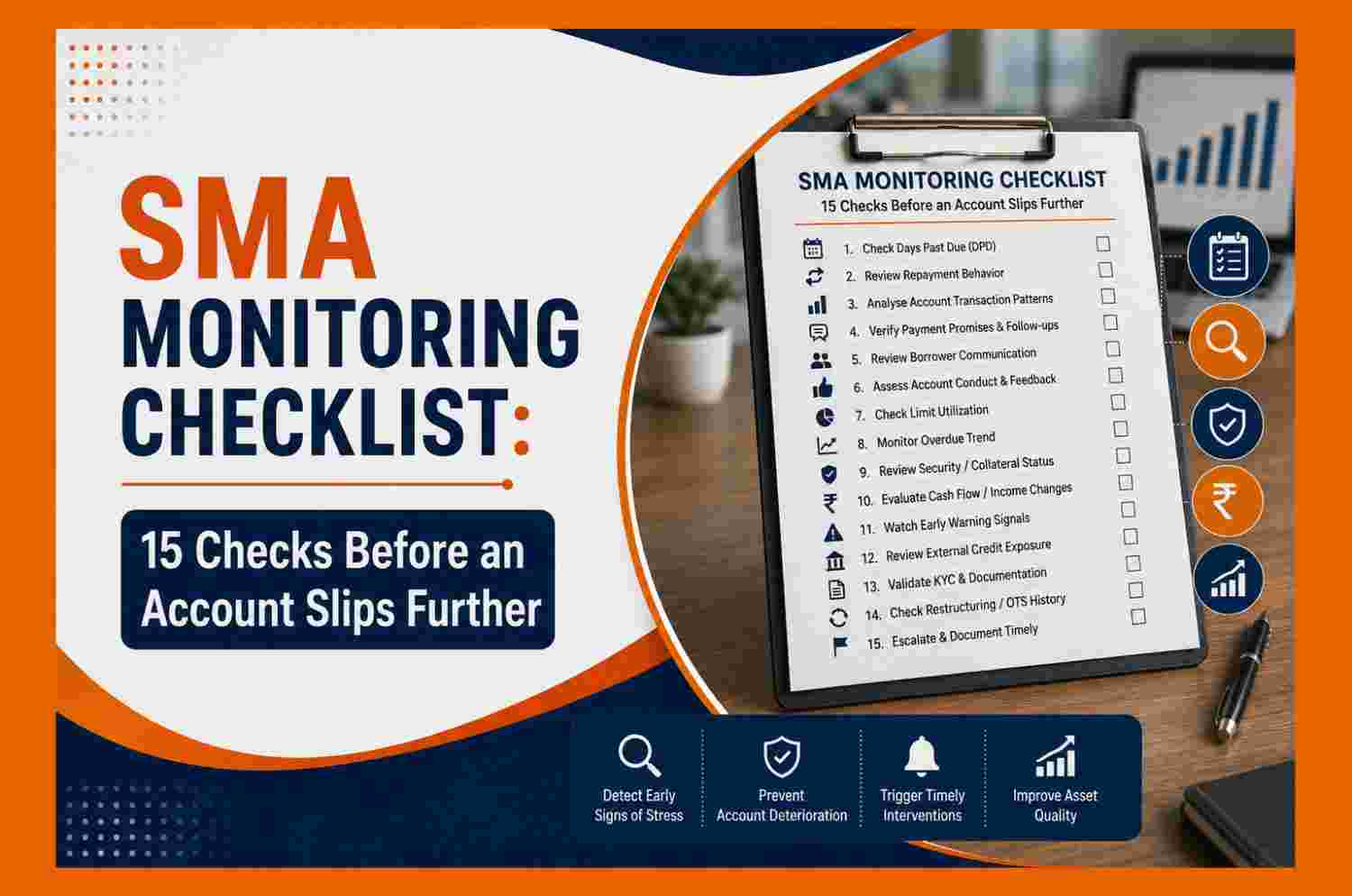
SMA Monitoring Checklist: 15 Checks Before an Account Slips Further
Once a loan account enters Special Mention Account territory, the difference between recovery and a slide into NPA usually comes down to how disciplined the monitoring is during that window. The RBI’s SMA framework gives banks a structured early warning system, but it only works if credit and risk teams follow through with consistent checks at every stage. This SMA monitoring checklist breaks the process down into the checks that matter most, so credit officers, branch managers, and risk teams know exactly what to verify before an account slips from SMA-0 to SMA-1, from SMA-1 to SMA-2, or worst of all, into NPA classification.
Start With the Basics of the Account Itself
Before anything else, the fundamentals of the classification need to be right. Every SMA classification is anchored to the exact date the account first became overdue, based on the bank’s day end process, and this date determines when the account will cross into the next stage. It is also worth remembering that SMA tagging happens automatically through the core banking system, but data errors do occur around part payments, standing instruction failures, or reversed transactions, so the classification itself should always be verified against the actual overdue amount before any review begins. Recent stage movement, such as an account that has just crossed from SMA-1 to SMA-2, often signals accelerating stress and deserves faster escalation than one that has been static for weeks. For a full breakdown of how these stages differ, see our SMA-0 vs SMA-1 vs SMA-2 complete guide.
Understand Why the Account Is Under Stress
Classification data only tells part of the story. The real diagnostic work happens when the team looks at the borrower’s behaviour and circumstances directly. A few checks matter most here.
- Review 12 months of repayment history to see whether the current delay is an isolated event or part of a recurring pattern.
- Identify the actual reason for the delay through direct borrower contact, whether it is a cash flow mismatch, a change in income, or a dispute over loan terms.
- Scan for early warning signals beyond the overdue itself, such as cheque bounces, falling account turnover, or delayed financial statements.
- Check the borrower’s exposure across other lenders reporting to CRILC, since multi-bank stress usually points to a deeper underlying problem.
Our detailed guide on early warning signals in banking covers the full range of indicators worth tracking beyond the overdue itself.
Confirm Compliance Requirements Are Being Met
Alongside the credit review, there are regulatory obligations that cannot slip through the cracks. For borrowers with aggregate exposure of five crore rupees and above, SMA classification must be reported to the Central Repository of Information on Large Credits within prescribed timelines, and this reporting should be verified as actually completed, not just assumed. Banks are also required to maintain board-approved policies for the timely identification and resolution of stressed assets, so it is worth periodically confirming that the monitoring steps being followed for a given account align with that internal policy framework rather than informal practice. Read our explainer on CRILC reporting and RBI’s large credit monitoring system for the full reporting requirements.
Assess the Financial Picture and Decide the Next Step
With the diagnostic and compliance checks done, the final stage is deciding what to actually do about the account. This is where the following checks come in.
- Assess collateral and security cover to confirm it still adequately protects the bank’s exposure.
- Evaluate the borrower’s latest financial statements for business and corporate accounts to judge whether the stress is temporary or structural.
- Decide whether restructuring or a revised repayment plan fits, where the borrower shows genuine willingness to cooperate.
SMA-2 accounts should always be escalated to senior credit or risk officers rather than left with the relationship manager alone, since this is generally the last practical opportunity to prevent NPA classification. Our guide on what banks should do when an account enters SMA-1 or SMA-2 covers these resolution options in more depth.
Keep the Clock in View
Every check above ultimately serves one purpose, which is buying enough time to act before the account crosses into NPA. Documenting every borrower interaction and always knowing exactly how many days remain before the next classification threshold should drive the urgency of the entire process. To see the complete journey and where a given account sits within it, see our guide on Day 1 overdue to NPA: the complete borrower stress timeline.
Build This Skillset With RMAI
Running this checklist consistently takes more than a template. It requires trained judgement in reading early warning signals, applying SMA classification correctly, and structuring recovery decisions. RMAI’s Online Certificate Course in NPA Management and Stressed Asset Governance builds exactly this applied capability across the credit lifecycle, from early warning detection to restructuring and recovery frameworks.
Conclusion
These checks work best as a system, not a one-off exercise. Banks that apply them consistently, rather than only once an account is deep into SMA-2, give themselves the strongest chance of keeping accounts out of NPA.
Related Reading
- Day 1 Overdue to NPA: The Complete Borrower Stress Timeline
- SMA-0 vs SMA-1 vs SMA-2: Complete Guide
- SMA-1 Explained: What a 31–60 Days Overdue Loan Means
- What Should Banks Do When an Account Enters SMA-1 or SMA-2?
- CRILC Reporting Explained: RBI’s Large Credit Monitoring System
- Early Warning Signals (EWS) in Banking