
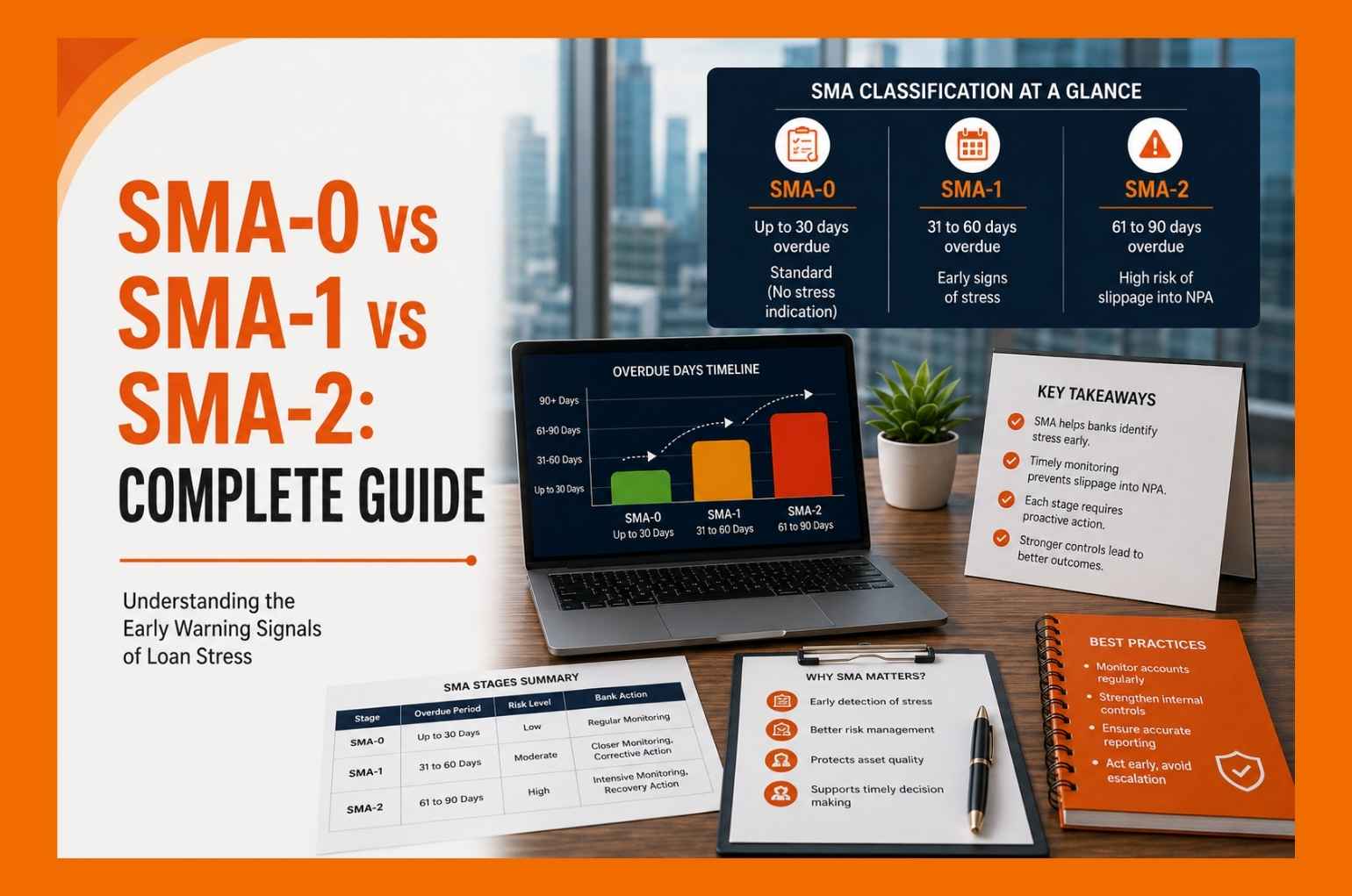
SMA-0 vs SMA-1 vs SMA-2: Complete Guide
The answer lies in Special Mention Account (SMA) classification. Before a borrower defaults for a prolonged period, banks identify early signs of repayment stress and classify the account into different SMA categories. This helps lenders intervene early, engage with borrowers, and prevent loans from deteriorating into NPAs.
The Reserve Bank of India (RBI) requires banks and lending institutions to identify stressed loan accounts at the earliest by classifying them as SMA-0, SMA-1, and SMA-2 based on the number of days a payment remains overdue.
What is a Special Mention Account (SMA)?
A Special Mention Account (SMA) is a loan account that has started showing signs of financial stress but has not yet become a Non-Performing Asset (NPA).
Think of SMA as an early warning system for banks.
Instead of waiting until a borrower completely stops repaying the loan, banks continuously monitor repayment behaviour. If repayments are delayed, the account is classified into different SMA categories depending on the number of overdue days.
This allows banks to:
- Detect financial stress early
- Increase monitoring of risky accounts
- Engage with borrowers before the situation worsens
- Reduce the chances of loans becoming NPAs
- Improve recovery outcomes
SMA-0 vs SMA-1 vs SMA-2: Quick Comparison
| Classification | Overdue Period* | Risk Level | Bank’s Focus |
|---|---|---|---|
| SMA-0 | 1–30 days | Early Warning | Monitor and engage borrower |
| SMA-1 | 31–60 days | Moderate Risk | Close monitoring and corrective action |
| SMA-2 | 61–90 days | High Risk | Immediate intervention and resolution planning |
| NPA | More than 90 days (for term loans, subject to applicable RBI norms) | Default | Recovery and provisioning |
*For loans other than revolving credit facilities. Different rules apply to cash credit, overdraft and certain other loan products.
Why Did RBI Introduce SMA Classification?
Earlier, banks primarily focused on accounts after they became NPAs. By that stage, recovery was often more difficult.
The SMA framework was introduced to encourage early identification of stressed accounts, allowing banks to take preventive action before the borrower defaults completely.
The objective is simple:
Identify stress early → Monitor closely → Take corrective action → Reduce NPAs
This proactive approach strengthens credit monitoring and improves the overall quality of loan portfolios.
Understanding SMA-0
An account is generally classified as SMA-0 when the payment is overdue for up to 30 days for eligible loan categories.
This is the first indication that something may be affecting the borrower’s repayment ability.
Common reasons for SMA-0
- Temporary cash flow issues
- Delay in customer payments
- Operational disruptions
- Short-term business slowdown
- Administrative delays
What should banks do?
At this stage, the objective is prevention rather than recovery.
Banks typically:
- Contact the borrower
- Understand the reason for delay
- Review recent account behaviour
- Monitor repayment trends
- Record follow-up actions
Many SMA-0 accounts return to normal once the borrower clears the overdue amount.
Understanding SMA-1
If the overdue continues for 31 to 60 days, the account generally moves to SMA-1.
At this stage, the financial stress appears more serious and requires greater attention.
Bank’s focus during SMA-1
Credit officers usually review:
- Borrower’s financial position
- Cash flow situation
- Business performance
- Account turnover
- Security and collateral
- Compliance with loan conditions
Banks may also increase the frequency of monitoring and escalate the account to higher authorities if required.
The objective is to determine whether the borrower can realistically regularise the account before it deteriorates further.
Understanding SMA-2
An account generally becomes SMA-2 when payments remain overdue for 61 to 90 days.
This is the final warning stage before the account may become an NPA.
By this point, banks usually conduct a comprehensive review of the account.
Key actions during SMA-2
- Detailed financial assessment
- Borrower meetings
- Review of collateral and documentation
- Evaluation of repayment capacity
- Resolution planning
- Recovery preparedness
- Escalation to stressed asset teams where applicable
Since the account is approaching NPA classification, decisions taken during SMA-2 can significantly influence recovery outcomes.
How Does an Account Move from SMA to NPA?
A simplified loan stress timeline looks like this:
Regular Loan Account
↓
Payment becomes overdue
↓
SMA-0 (1–30 days)
↓
SMA-1 (31–60 days)
↓
SMA-2 (61–90 days)
↓
NPA (More than 90 days for eligible term loans)
The earlier banks identify and resolve repayment issues, the greater the chances of preventing the account from becoming an NPA.
Who Monitors SMA Accounts in a Bank?
SMA management is not handled by a single department.
Several teams work together throughout the loan lifecycle.
| Department | Primary Responsibility |
|---|---|
| Branch Credit Team | Initial borrower follow-up |
| Credit Monitoring Team | Monitor overdue accounts and SMA classification |
| Credit Risk Team | Portfolio review and risk assessment |
| Stressed Asset Team | Review high-risk accounts and resolution options |
| Recovery Team | Collection and recovery activities |
| Legal Team | Support enforcement and recovery proceedings |
| Internal Audit | Verify correct SMA/NPA classification and compliance |
This coordinated approach ensures that stressed accounts receive timely attention before they become serious defaults.
Common Mistakes in SMA Monitoring
Even with automated systems, effective monitoring requires judgement and timely action.
Some common mistakes include:
- Waiting until the account becomes an NPA
- Ignoring early warning signals
- Delayed borrower engagement
- Inadequate documentation
- Poor coordination between departments
- Treating every overdue account as a routine collection issue
Strong credit monitoring combines system alerts with professional analysis and proactive borrower communication.
Why SMA Classification Matters
For banks and lending institutions, SMA classification is more than a regulatory requirement.
It helps institutions:
- Improve credit monitoring
- Detect financial stress early
- Reduce future NPAs
- Strengthen portfolio quality
- Support informed lending decisions
- Improve recovery planning
For banking professionals, understanding SMA classification is an essential skill in credit monitoring, branch banking, risk management and stressed asset governance.
Frequently Asked Questions
What does SMA stand for in banking?
SMA stands for Special Mention Account, which refers to a loan account showing early signs of financial stress before it becomes an NPA.
What is the difference between SMA-0, SMA-1 and SMA-2?
The difference is based on the number of overdue days and the level of financial stress. SMA-0 represents early stress, SMA-1 indicates moderate stress, and SMA-2 reflects a higher level of stress requiring immediate attention.
Does SMA-2 mean the loan has become an NPA?
No. SMA-2 is generally the final stage before NPA classification. If the overdue continues beyond the applicable RBI threshold, the account may then be classified as an NPA.
Can an SMA account become normal again?
Yes. If the borrower clears the overdue amount and the account is regularised in accordance with applicable norms, it can return to normal status.
Key Takeaways
SMA classification enables banks to identify loan stress before it becomes a major problem. SMA-0 represents the first warning, SMA-1 indicates increasing repayment stress, and SMA-2 signals that the account is approaching NPA status. By taking timely corrective action at each stage, banks can strengthen credit monitoring, improve recovery prospects, and reduce the number of accounts slipping into NPAs.
Related Professional Learning
Professionals working in credit monitoring, branch banking, recovery, stressed asset management, and loan administration can deepen their understanding through the NPA Management and Stressed Asset Governance course, which covers SMA classification, early warning signals, NPA recognition, recovery strategies, and regulatory expectations in detail.