
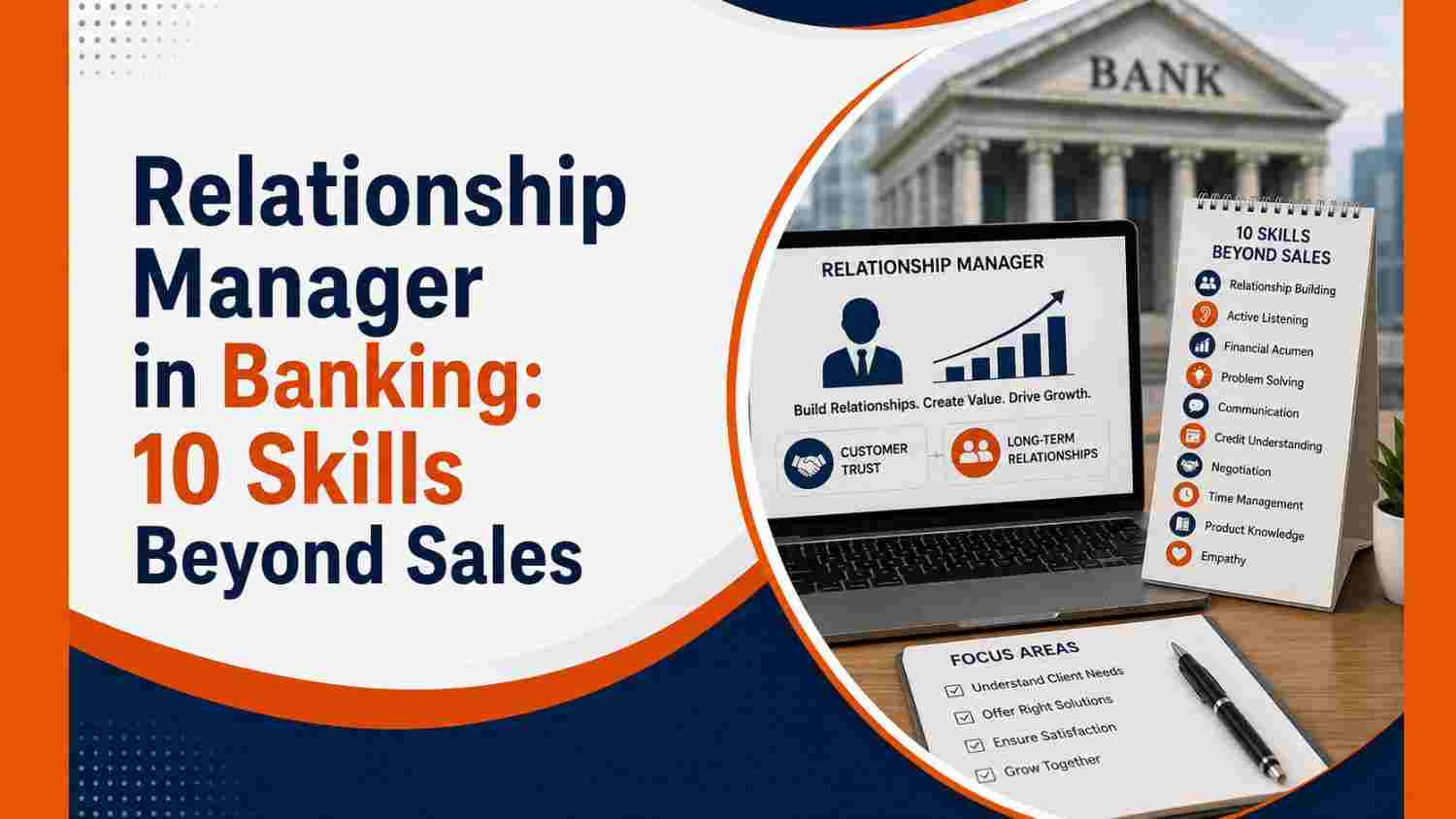
Relationship Manager in Banking: 10 Skills Beyond Sales
Ask most people what a relationship manager does, and the answer usually starts and ends with sales. It is not wrong, RMs do carry targets across deposits, loans, and cross sell products, and meeting those numbers matters. But the relationship managers who build genuinely large, sticky client books over a decade are rarely the ones who were simply the best closers in their first year. They are the ones who paired sales ability with a wider set of skills that most job descriptions barely mention.
If you are building a career as a relationship manager in banking, here are 10 skills worth developing alongside, not instead of, your sales craft.
1. Financial Product Depth
Selling a product well requires actually understanding it, not just its features but where it fits and where it does not. An RM who can explain why a particular loan structure or investment product suits one client and not another builds far more trust than one reciting a script. This depth also protects the client from being sold something unsuitable, which matters more for retention than any single transaction.
2. Basic Credit Judgment
RMs frequently source lending proposals, and understanding the fundamentals of credit assessment, what a bank actually looks for in a borrower’s financial statements and repayment capacity, helps an RM bring in proposals that move through approval smoothly instead of getting stuck at the credit desk. Even a working knowledge of credit risk management makes an RM a stronger partner to both the client and the bank’s credit team.
3. Active Listening
The difference between hearing a client and actually listening shows up quickly in the quality of advice that follows. A client mentioning an upcoming business expansion, a child’s education plans, or a change in cash flow is handing an RM information that, if picked up on, leads to relevant recommendations rather than generic product pushes. Many missed cross sell opportunities are simply missed listening opportunities.
4. Financial Planning Fundamentals
Clients increasingly expect an RM to think beyond the single product being discussed and place it in the context of their broader financial picture, savings goals, risk appetite, tax considerations, and life stage. RMs who can hold this bigger picture conversation position themselves as advisors rather than salespeople, which is a distinction clients notice and reward with loyalty.
5. Regulatory and Compliance Awareness
KYC norms, suitability requirements for investment products, and disclosure obligations are not back office concerns for an RM, they are front line responsibilities. An RM who understands these requirements protects both the client and themselves from problems that surface much later, often at the worst possible time.
6. Risk Sensitivity
Recognising early signs of financial stress in a client, a business account with declining turnover, a personal account with rising overdraft usage, allows an RM to have a proactive conversation before the relationship turns into a collections problem. This kind of risk sensitivity, closely related to the early warning signals credit teams track, is something the best RMs develop instinctively and the rest have to build deliberately.
7. Data and CRM Fluency
Managing a growing client book without systematic tracking eventually breaks down. Comfort with CRM tools, basic portfolio analytics, and even simple Excel tracking helps an RM manage a larger book without letting relationships go quiet, which is one of the most common reasons clients drift to a competitor.
8. Negotiation Without Over-Promising
Negotiating pricing, terms, or turnaround time with internal teams on a client’s behalf is a real skill, but so is knowing where the line sits. RMs who over-promise to win a deal in the short term tend to spend far more time managing the fallout later. The best negotiators protect the relationship’s long term credibility as much as the immediate transaction.
9. Emotional Resilience
Targets get missed some quarters, clients get upset over things outside an RM’s control, and market downturns test even the strongest relationships. Staying composed and constructive through these periods, rather than becoming defensive or disengaged, is what keeps both the client relationship and the RM’s own performance on track.
10. Long Term Relationship Thinking
The most consistently successful RMs make decisions with a multi-year view of the relationship rather than optimising for this quarter’s number. This sometimes means not pushing a product that technically meets target but does not genuinely serve the client, a call that costs something in the short term and pays back many times over in retention and referrals.
Building These Skills Systematically
The credit and risk related skills on this list, in particular, are rarely covered in standard RM training but make a measurable difference in how proposals move and how early problems get caught. A focused credit risk management course gives RMs the working knowledge of credit assessment that strengthens both proposal quality and client conversations.
For a wider view of the compliance and product knowledge that supports strong client relationships, a broader set of banking courses covers areas like KYC, customer due diligence, and fraud risk awareness, all of which sit close to an RM’s daily work.
Conclusion
Sales ability gets a relationship manager in banking through the first few years. What sustains a career beyond that is the combination of product depth, credit judgment, listening, and long term thinking that turns a transactional client into a lasting relationship. Build these ten skills alongside your sales craft, and the numbers tend to follow rather than lead.