
Architecture of Bonds: A Deep Dive into Fixed Income Securities

In India, the bond market has evolved significantly over the years, offering a wide range of products to cater to the diverse needs of investors. This article delves into the various aspects of bonds, their types, valuation methods, and the factors affecting their prices, with a specific focus on the Indian market. Bonds are a cornerstone of the global financial system, providing a stable and reliable form of investment for institutions and individual investors alike.
Definition of Bond:
A bond is a fixed-income financial instrument that represents a loan made by an investor to a borrower, typically a corporation or government. In essence, when you purchase a bond, you are lending money to the issuer in exchange for periodic interest payments and the return of the bond’s face value when it matures.
Bonds are often referred to as debt securities, and they are a critical component of the financial market, offering a safer investment alternative compared to equities. Bonds are favored by conservative investors due to their relatively lower risk and predictable returns.
Who Issues Bonds and Why?
Bonds are issued by various entities, including:
1. Governments (Central and State): To finance public projects like infrastructure development, healthcare, education, and defence. In India, government bonds are known as Government Securities (G-Secs) or Treasury Bills (T-Bills).
2. Corporations: To raise capital for business expansion, mergers and acquisitions, or to refinance existing debt. Corporate bonds in India are issued by companies across various sectors like banking, manufacturing, and utilities.
3. Municipalities: Local governments issue bonds to fund public projects within their jurisdiction, such as schools, highways, and water systems. These bonds are less common in India but are gaining traction.
4. Financial Institutions: Banks and other financial entities issue bonds to manage their capital structure and liquidity requirements.
Issuers prefer bonds as they provide an opportunity to raise large sums of money without giving up equity or ownership in their company. Additionally, bonds often come with lower interest rates compared to other forms of borrowing, such as bank loans.
Different Types of Bonds
1. Zero-Coupon Bonds
Zero-coupon bonds are issued at a discount to their face value and do not pay periodic interest. Instead, investors receive the bond’s face value at maturity. The difference between the purchase price and the face value represents the investor’s return.
Example: Suppose the Government of India issues a zero-coupon bond with a face value of ₹10,000 at a discounted price of ₹7,500. After ten years, the bond matures, and the investor receives ₹10,000, earning a profit of ₹2,500.
2. Coupon-Paying Bonds
Coupon-paying bonds provide regular interest payments to investors, typically annually or semi-annually. The interest rate, known as the coupon rate, is fixed and is a percentage of the bond’s face value.
Example: A corporate bond with a face value of ₹1,00,000 and a coupon rate of 7% will pay ₹7,000 annually to the bondholder until maturity.
3. Fixed and Floating Rate Bonds
- Fixed-Rate Bonds: These bonds have a fixed coupon rate that remains unchanged throughout the bond’s life. Investors know exactly how much interest they will receive, making these bonds relatively low risk.
Example: A fixed-rate bond with a 6% coupon rate will pay ₹6,000 annually on a face value of ₹1,00,000, irrespective of market interest rates.
- Floating Rate Bonds: These bonds have a variable coupon rate that is typically linked to a benchmark interest rate, such as the Reserve Bank of India’s (RBI) repo rate. The interest payments fluctuate with changes in the benchmark rate.
Example: A floating rate bond with a coupon rate linked to the RBI’s repo rate might have an initial rate of 5%. If the repo rate increases, the bond’s coupon rate will also increase, providing higher interest payments to the investor.
4. Convertible Bonds
A convertible bond is a type of hybrid security, combining features of both debt and equity. It is a bond issued by a company that can be converted into a predetermined number of shares of the issuing company’s stock at certain times during the bond’s life, typically at the discretion of the bondholder. These bonds offer investors the option to convert their debt into equity, providing potential upside if the company performs well.
5. Inflation-Adjusted Bonds
Inflation-adjusted bonds, also known as inflation-linked bonds, provide protection against inflation. The principal amount of the bond and the interest payments are adjusted according to changes in the inflation rate. It may also be considered as type of floating rate bond.
Example: The Government of India issues Inflation-Indexed Bonds (IIBs) where the principal and interest payments increase with inflation, ensuring that the investor’s purchasing power is maintained.
6. Callable and Putable Bonds
- Callable Bonds: These bonds can be redeemed by the issuer before maturity at a specified price. Issuers may call bonds when interest rates fall, allowing them to refinance the debt at a lower rate.
Example: A company issues a callable bond with a 10-year maturity but decides to redeem it after five years when interest rates drop, allowing them to issue new bonds at a lower rate.
- Putable Bonds: These bonds give the investor the right to sell the bond back to the issuer at a predetermined price before maturity. Investors might exercise this option if interest rates rise, enabling them to reinvest at higher rates.
Example: An investor holds a putable bond but decides to sell it back to the issuer when market interest rates increase, thus avoiding losses due to falling bond prices.
Valuation of Bonds
Bond valuation is a critical aspect of bond investing. The value of a bond is determined by the present value of its future cash flows, which include both interest payments and the principal repayment at maturity.
Present Value Formula
Let us assume the following.
- C = Annual coupon payment (₹60)
- r = Market interest rate or discount rate (8% or 0.08)
- n = Number of years to maturity (5 years)
- F = Face value (₹1,000)
Step-by-Step Calculation:
1. Calculate the Present Value of Coupon Payments: The bond pays ₹60 per year for 5 years. The present value of these coupon payments is calculated by discounting each payment.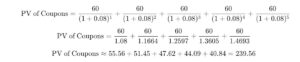
Calculate the Present Value of the Face Value: The bond’s face value of ₹1,000 is paid at the end of 5 years, and its present value is:

Calculate the Total Bond Value:
Bond Value= PV of Coupons + PV of Face Value = 239.56 + 680.58 ≈ ₹ 920.14
Build-Up Approach for Bond Valuation
The build-up approach is a method used to estimate the required rate of return on a bond by adding various risk premiums to the risk-free rate. The components typically include:
1. Risk-Free Rate: The return on government bonds (G-Secs) is often used as the risk-free rate.
2. Inflation Premium: Compensates investors for the loss of purchasing power due to inflation.
3. Credit Risk Premium: Reflects the issuer’s creditworthiness. Higher-risk issuers must offer a higher premium.
4. Liquidity Premium: Accounts for the ease of trading the bond. Less liquid bonds carry a higher premium.
5. Maturity Premium: Longer-term bonds generally have higher returns to compensate for greater risk.
Example: If the risk-free rate is 4%, the inflation premium is 2%, the credit risk premium is 3%, and the liquidity premium is 1%, the required rate of return would be 10%.
Trading of Bonds
Bonds can be traded in the secondary market, where prices fluctuate based on supply and demand, interest rates, and other economic factors.
Trading at Par, Premium, and Discount
- At Par: A bond is said to be trading at par when its market price is equal to its face value. This usually occurs when the coupon rate is equal to the current market interest rate.
- At Premium: A bond trades at a premium when its market price is higher than its face value. This occurs when the coupon rate is higher than the current market interest rate.
Example: A bond with a face value of ₹1,00,000 and a coupon rate of 8% will trade at a premium if current interest rates are 6%, as investors will pay more for the higher coupon payments.
- At Discount: A bond trades at a discount when its market price is lower than its face value. This happens when the coupon rate is lower than the
- Example: If the coupon rate is 5% but current market rates are 7%, the bond will trade at a discount because investors can find better returns elsewhere.
Factors Affecting Bond Prices
Several factors influence bond prices in the market:
1. Interest Rates: The most significant factor affecting bond prices is the prevailing interest rates. When interest rates rise, bond prices fall, and vice versa.
2. Credit Ratings: Bonds with higher credit ratings from agencies like CRISIL or ICRA will trade at higher prices, reflecting lower default risk.
3. Inflation: Higher inflation expectations reduce the purchasing power of future cash flows, leading to lower bond prices.
4. Economic Conditions: During economic downturns, investors prefer safer investments like government bonds, driving up their prices and lowering yields.
5. Liquidity: Bonds that are easier to buy and sell will typically have higher prices due to their liquidity.
6. Supply and Demand: An increase in the supply of bonds or a decrease in demand can lower prices, while a decrease in supply or an increase in demand can raise prices.
The bond market in India offers a diverse range of investment opportunities, from government securities to corporate bonds, each with its own set of characteristics and risks. Understanding the different types of bonds, their valuation, and the factors influencing their prices is crucial for making informed investment decisions. As the Indian bond market continues to evolve, investors must stay informed about market trends and economic conditions to optimize their returns.
Authored by:
Nilotpal Banerjee
Chief Manager (Faculty)
Staff Training Centre, Powai