
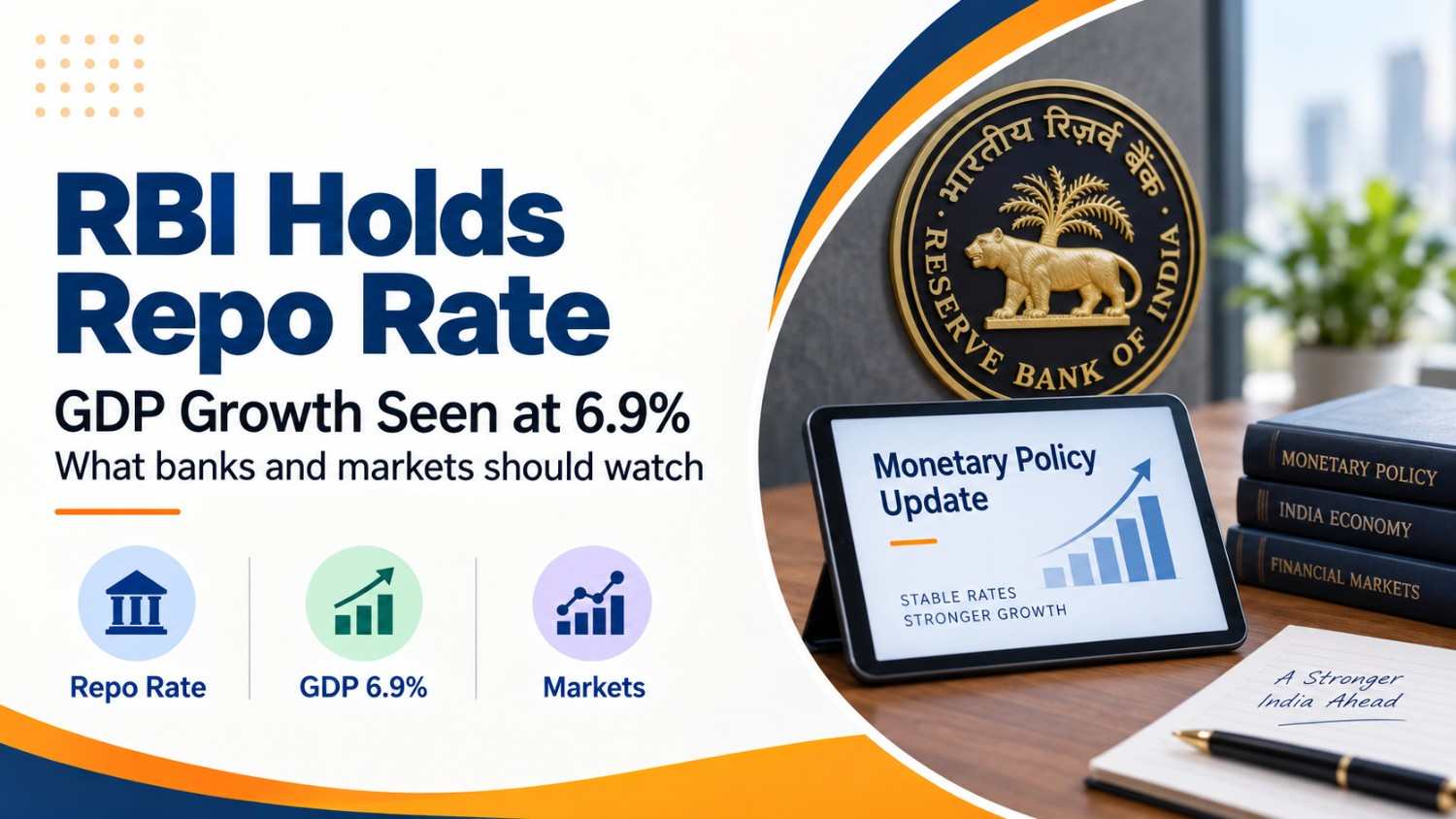
RBI Keeps Repo Rate Unchanged, Projects India’s GDP Growth at 6.9%
The RBI repo rate unchanged GDP growth 6.9% decision from the Monetary Policy Committee, chaired by Governor Sanjay Malhotra, signals a period of policy steadiness even as the central bank turns notably more confident on growth. Holding the repo rate steady while projecting real GDP growth for the current fiscal at 6.9 percent tells banks, NBFCs, and treasury teams that the committee sees the economy on a stronger footing than earlier estimates suggested, without feeling the need to adjust the cost of money to support that momentum. For banking and finance professionals, a pause is rarely just a pause. It carries signals about credit demand, deposit pricing, and how the rest of the fiscal year is likely to unfold.
What the RBI’s Decision Actually Signals
A rate pause combined with an upgraded growth projection is a specific kind of signal, distinct from a pause driven by inflation caution or global uncertainty. It suggests the MPC views current policy settings as broadly appropriate for supporting growth that is already running ahead of earlier expectations, rather than needing further easing to stimulate activity.
- The repo rate stays unchanged, keeping the cost of funds for banks stable and avoiding an immediate reset of lending and deposit rate benchmarks
- Real GDP growth for the current fiscal is projected at 6.9 percent, an upward signal on the health of consumption, investment, or both, depending on which components are driving the revision
- A steady policy rate alongside stronger growth generally points to the committee’s assessment that inflation remains within a comfortable range even as economic activity firms up
Read Now: CRILC Reporting Explained: RBI’s Large Credit Monitoring System
How This Affects Bank Lending and Deposit Strategy
An unchanged repo rate means banks are not forced into an immediate repricing exercise across their loan and deposit books, but it does not mean business as usual either. A stronger growth outlook typically feeds through into credit demand assumptions well before any rate action follows it.
- Loan growth assumptions for the remainder of the fiscal year may need revising upward if credit demand tracks the improved GDP outlook, particularly in retail and MSME segments
- Deposit pricing strategy stays largely stable in the near term, since the cost of funds benchmark has not moved, though competitive pressure for deposits can still build independently of the policy rate
- Asset liability management teams should treat this as a signal to revisit growth linked lending targets rather than repricing models, since the transmission here runs through volume rather than rate
Implications for Credit Risk and Asset Quality
A stronger growth projection generally supports better borrower cash flows and improved repayment capacity across most segments, which is constructive for asset quality trends. At the same time, an upgraded growth forecast is not a substitute for account level monitoring, since aggregate growth figures can mask uneven performance across sectors and borrower categories.
- Improved macro conditions can support faster regularisation of accounts sitting in early SMA stages, provided banks maintain active borrower engagement rather than assuming improvement happens automatically
- Sector level dispersion matters more than the headline number, since a 6.9 percent aggregate growth figure can still coexist with pockets of stress in specific industries or borrower segments
- Credit underwriting assumptions built during a slower growth phase may need revisiting to reflect the more favourable environment reflected in this projection
Read Now: Cash Credit vs Overdraft: 7 Practical Differences
What Treasury and Risk Teams Should Watch Next
A rate pause is rarely the final word for the rest of the fiscal year, and treasury and risk functions should treat this decision as one data point in an evolving picture rather than a settled position. The next few policy reviews will show whether the improved growth outlook holds up against incoming data, and whether it eventually feeds through into a shift in the policy stance.
- Liquidity planning should factor in the possibility of stronger than expected credit growth putting incremental pressure on funding requirements over the year
- Interest rate risk positioning should account for the fact that an unchanged rate today does not rule out a shift in either direction at future reviews, particularly if growth continues to outperform
- Board and ALCO reporting should reflect the updated growth assumption clearly, since it forms part of the macro backdrop against which the year’s lending and provisioning plans are being tracked
Conclusion
The RBI’s decision to hold the repo rate while projecting 6.9 percent real GDP growth for the current fiscal reflects confidence in the underlying economy rather than a call for immediate action from banks. The real work now lies in translating that confidence into updated credit, liquidity, and risk assumptions rather than treating it as a routine policy footnote.
Build This Capability with RMAI
RMAI supports banking and treasury professionals through the Online Certificate Course in Credit Risk Management and the Online Certificate Course in NPA Management and Stressed Asset Governance, both directly relevant to reassessing credit and asset quality assumptions in light of the RBI’s updated growth outlook.