
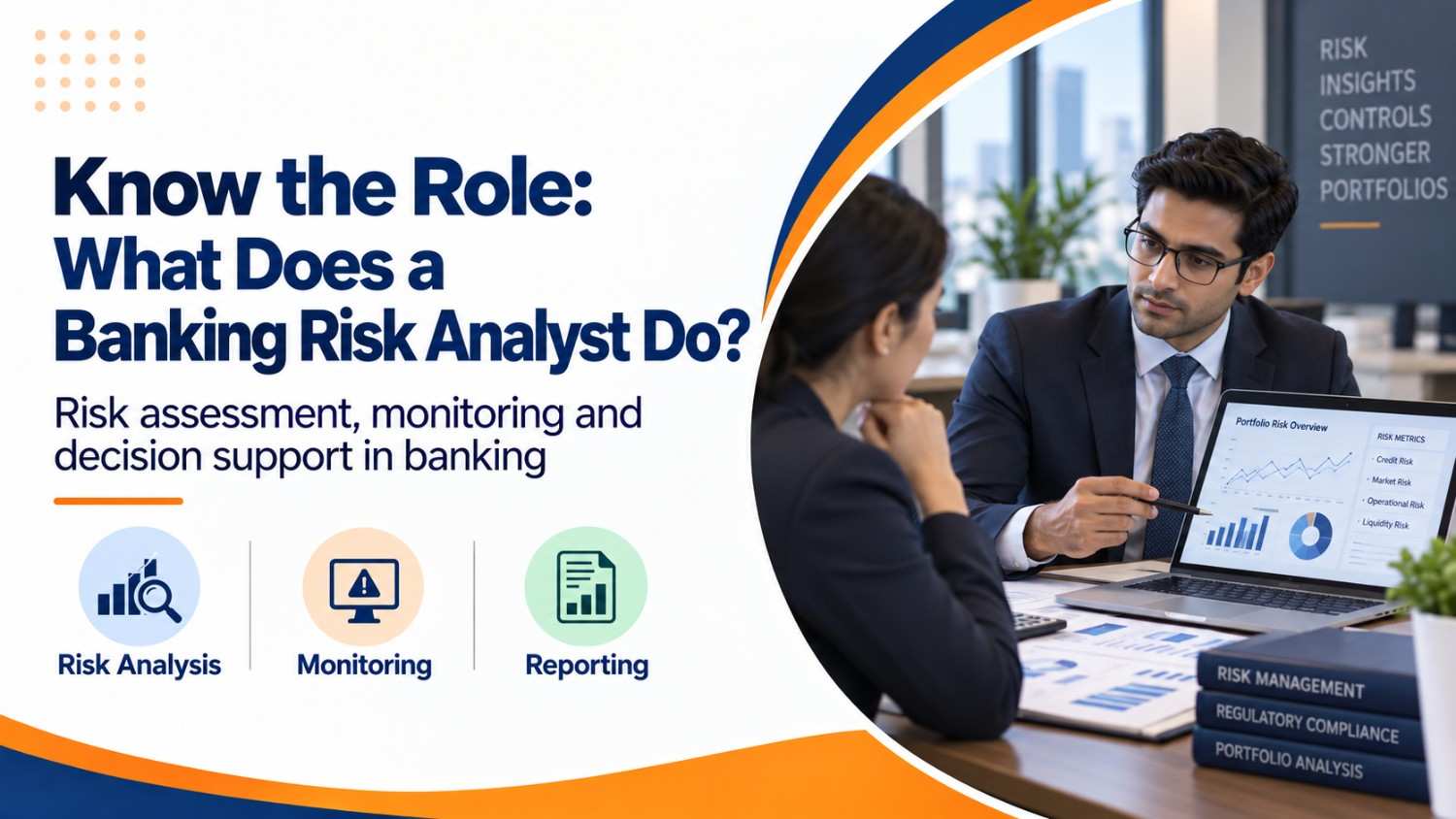
Know the Role: What Does a Banking Risk Analyst Do?
The job title Risk Analyst gets used loosely across banking, and that vagueness does the role a disservice. A Banking Risk Analyst role is not simply a person who builds spreadsheets and flags numbers that look off. It is a function built around identifying where a bank’s exposure could turn into a real loss, tracking that exposure as it changes, and making sure the right people see it before it becomes a problem rather than after. This piece breaks down what the role actually covers day to day, the different flavours it comes in, and what separates a competent risk analyst from a genuinely valuable one.
What a Risk Analyst Is Actually Responsible For
Strip away the specific risk category, and most risk analyst roles share a common core. The job exists to turn raw data about the bank’s exposures into something decision makers can actually act on, and that translation work is harder than it sounds.
- Collecting and validating exposure data from credit, market, or operational sources, since analysis built on bad data is worse than no analysis at all
- Running the models and calculations relevant to the risk category, whether that is a credit scoring model, a value at risk calculation, or an operational loss projection
- Producing regular risk reports for senior management, risk committees, or the board, translating technical output into something a non specialist audience can act on
- Flagging breaches or near breaches of risk limits promptly, rather than letting them surface only during a scheduled review cycle
Credit Risk Analysis in Practice
For analysts working specifically on the credit side, the role centres on understanding borrower and portfolio level risk well enough to inform lending decisions and ongoing monitoring. This is often where new risk analysts start, since credit risk data tends to be the most structured and accessible.
- Assessing borrower creditworthiness using financial statements, credit scores, and repayment history as inputs into lending decisions
- Monitoring portfolio quality over time, tracking metrics like delinquency rates, SMA classification trends, and concentration against single borrowers or sectors
- Supporting provisioning calculations under frameworks like Expected Credit Loss, which require ongoing estimation of probability of default and loss given default rather than a one time assessment
Read Now: NPA Recognition vs Provisioning: They Are Related, But Not the Same
Operational and Market Risk Analysis
Not every risk analyst spends their day on credit portfolios. A significant share of the role, particularly in larger banks, sits on the operational and market risk side, where the sources of loss look very different from a missed loan repayment.
- Tracking operational loss events, from process failures to fraud incidents, and analysing patterns that point to systemic weaknesses rather than isolated errors
- Monitoring market risk exposures, including interest rate and foreign exchange positions, against approved limits and changing market conditions
- Conducting scenario and stress testing, modelling how the bank’s positions would perform under adverse but plausible conditions rather than only business as usual assumptions
Escalation and Governance Responsibilities
Analysis that never reaches the right person at the right time has limited value, which makes escalation judgement a core part of the role rather than an administrative afterthought. A good risk analyst knows the difference between something worth flagging immediately and something that belongs in the next scheduled report.
- Escalating limit breaches or emerging risk concentrations to risk committees or senior management as soon as they are identified, not after the fact
- Contributing to risk registers and governance documentation that support audit, regulatory review, and board level oversight
- Coordinating with credit, treasury, or operations teams whose activities directly generate the risk data being analysed, since risk analysis rarely happens in isolation from the business
Read Now: SMA Monitoring Checklist: 15 Checks Before an Account Slips Further
Skills That Define a Strong Risk Analyst
The technical side of the role is only half the picture. Analysts who advance quickly tend to combine strong quantitative ability with the communication skills needed to make their analysis actually influence decisions.
- Quantitative and analytical skill, enough to work confidently with statistical models, spreadsheets, and increasingly, risk analytics software rather than relying purely on templates
- Regulatory literacy, understanding how frameworks like Basel norms, IRAC classification, or RBI directions on specific risk types shape what the analysis needs to cover
- Clear written and verbal communication, since the best risk insight is worthless if a risk committee cannot understand or act on it quickly
Career Path and Progression
Risk analyst roles tend to offer a fairly clear route upward, particularly for analysts who develop depth in a specific risk category while retaining a working understanding of the others.
- Junior or Associate Risk Analyst roles typically focus on data preparation and standard reporting under closer supervision
- Senior Risk Analyst and Risk Manager roles take on model ownership, direct committee reporting, and greater responsibility for escalation decisions
- Specialisation or a move into Enterprise Risk Management is common for analysts who want to work across risk categories rather than staying within one silo
Conclusion
A Banking Risk Analyst role is ultimately about turning exposure data into decisions that protect the bank before a loss materialises, whether that exposure sits in a loan portfolio, a trading book, or an operational process. Understanding the full scope of the role, rather than reducing it to model building, is what makes the career path clearer for anyone considering it.
Build This Capability with RMAI
RMAI supports current and aspiring risk analysts through the Online Certificate Course in Credit Risk Management and the Online Certificate Course in NPA Management and Stressed Asset Governance, both directly relevant to the monitoring and escalation responsibilities covered above.