

India’s GIG Economy: “The Rise of Freelance India”

Introduction
The global economy is witnessing a significant transformation with the rise of the gig economy — a labour market characterized by short-term contracts, freelance work, and on-demand services as opposed to traditional full-time employment. In India, this shift is particularly prominent, driven by technological advances, changing work preferences, and the expansion of digital platforms. The gig economy offers flexibility and independence to workers while enabling businesses to reduce costs and scale rapidly. However, it also poses significant challenges related to job security, labour rights, and social protection.
The term “gig” originates from the music industry, where artists would take on short-term engagements or “gigs.” Over time, it came to signify any form of freelance, short-term, or flexible employment, especially facilitated by digital platforms.
In India, the gig economy began gaining momentum with the emergence of technology-driven companies like Ola, Uber, Swiggy, Zomato, and Urban Company. These platforms not only changed the way services are delivered but also how labour is organized. Instead of hiring full-time workers, these companies leveraged independent contractors, offering task-based work. This model soon expanded beyond transportation and food delivery to include areas like content writing, IT services, graphic design, housekeeping, tuition, and even legal or financial consultancy.
Scope & Growth
Current Size and Employment Trends in India:
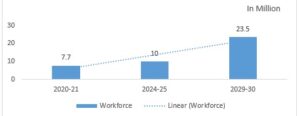
According to the report of NITI Aayog in 2022 the country has around 7.7 million gig workers in 2020-21, and this number is projected to grow to 23.5 million by 2029-30. This would account for nearly 4% of India’s total workforce.
The gig economy in India is not limited to low-skilled or blue-collar jobs. It encompasses a wide range of work arrangements, from food delivery executives to freelance software engineers, YouTube creators, consultants, and digital marketers.

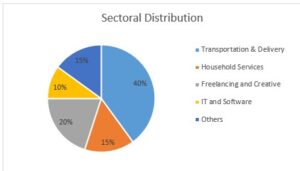
Sectoral Distribution: The gig economy in India spans a wide array of sectors, with transportation and delivery services (such as Ola, Uber, Swiggy, and Zomato) accounting for the largest share, employing nearly 40% of gig workers. Household services through platforms like Urban Company represent about 10–15%, while freelancing in creative and technical fields including writing, graphic design, and software development — comprises another 15–20%. The IT sector and professional consulting contribute around 10%, and the remaining 10–15% is spread across education, healthcare, finance, and other on-demand services. This diverse distribution underscores the gig economy’s growing integration into both blue and white-collar segments of the labour market.
Geographic and Demographic Trends:
Gig work is highly urban-centric, with metro cities like Delhi, Mumbai, Bengaluru, Hyderabad, and Pune leading the charge. However, the growing penetration of internet and smartphones is gradually bringing gig opportunities to Tier-II and Tier-III cities.
Interestingly, a large section of India’s gig workforce is young, typically between the ages of 20 and 35, and includes a growing number of women, especially in freelance and digital content creation roles.
Key Drivers of the GIG Economy in India
Digital Transformation:
 India’s digital revolution—driven by cheap data, widespread smartphone use, and expanding broadband—has laid the foundation for the gig economy. Platforms like Swiggy, Ola, and Urban Company use real-time tech to match workers with demand instantly, enabling flexible and accessible work opportunities. The rise of UPI and digital payments ensures fast, transparent earnings, attracting a diverse workforce across urban and rural regions. This connectivity has lowered barriers to entry, empowering youth, women, and the underemployed to participate in the economy. Overall, digital infrastructure has made gig work scalable, inclusive, and central to India’s evolving employment landscape.
Youth Demographics:
India’s median age of 28 reflects a young, energetic workforce that is digitally fluent and aspirational. Unlike previous generations that valued stable, long-term jobs, today’s youth prefer flexibility, autonomy, and varied income sources. This shift aligns perfectly with the gig economy, where workers can choose when, where, and how they work. Growing up with smartphones and internet access, young Indians are adept at using digital platforms to find freelance and on-demand jobs. Their mobility and willingness to explore new opportunities make them ideal participants in the gig workforce, positioning the gig economy as a mainstream employment model for India’s future.
Urbanisation and Consumer Demand:
Rising urbanization and a growing middle class in India have fuelled strong demand for quick, convenient services like ride-hailing, food delivery, and home maintenance. With busy schedules, nuclear families, and rising disposable incomes, urban consumers increasingly rely on platforms like Ola, Swiggy, and Urban Company for everyday needs. These services offer flexibility and ease, while gig platforms provide income opportunities for millions, especially semi-skilled and skilled workers. The synergy between urban consumer demand and on-demand service delivery has made these sectors hotspots for gig work, significantly contributing to the expansion and mainstream acceptance of India’s gig economy.
Entrepreneurial Skills:
An increasing number of Indians are opting for independent work, side incomes, and multi-interest careers, a shift accelerated by the COVID-19 pandemic. Job disruptions and remote work during the crisis led many to explore freelancing, online teaching, content creation, and delivery-based jobs. Platforms like Upwork, YouTube, and various gig apps became lifelines for income and self-expression. This period encouraged people to monetize hobbies, build new skills, and pursue flexible work arrangements. As a result, the concept of portfolio careers—balancing multiple roles or income streams—has gained traction, reinforcing the growth and acceptance of the gig economy across India’s workforce.
Corporate Adoption:
Established companies in India are embracing gig workers and freelancers to meet evolving business needs and reduce the overheads associated with permanent staffing. This shift is especially evident in specialized domains like UI/UX design, cybersecurity, digital marketing, and content creation, where demand for niche skills often outweighs the need for full-time roles. By hiring on a project basis, firms gain access to top-tier talent without long-term commitments, enabling faster turnaround and greater flexibility. This approach also supports innovation, as companies can tap into a diverse talent pool, while gig workers benefit from varied projects and greater professional autonomy.
Pros & Cons
The gig economy offers significant advantages for both individuals and businesses in India. One of its key strengths is flexibility, allowing workers to choose their schedules, workloads, and employers. This is particularly helpful for students, homemakers, and those balancing multiple responsibilities. Gig work also acts as an important source of income, especially during economic downturns. For example, during the COVID-19 pandemic, many turned to gig platforms to earn a livelihood when traditional jobs were lost.
Beyond income, gig work enables skill development by exposing individuals to diverse roles and industries. This helps them gain valuable experience and remain competitive in a changing job market. For businesses, especially startups and SMEs, hiring freelancers or contractors offers cost efficiency. It reduces expenses related to recruitment, training, and infrastructure while giving access to specialized skills. Overall, the gig economy creates a win-win situation—offering freedom and earning potential to workers and flexibility to businesses.
While the gig economy offers flexibility and income opportunities, it also comes with several challenges. A major concern is the lack of job security, as gig workers are usually classified as independent contractors and do not receive benefits like paid leave, health insurance, or job protection. This is compounded by income volatility, since earnings fluctuate based on demand, platform policies, and algorithms.
Another issue is the absence of a social security net. Most gig workers are excluded from schemes like EPF, ESI, or pensions, leaving them financially vulnerable during illness, unemployment, or old age. Platform dependency is also a critical challenge, as gig workers rely heavily on digital platforms that can change rules, incentives, or ratings with little warning or consultation.
Additionally, gender disparities pose serious concerns. Women in gig work often face safety risks, especially during late hours, along with challenges like lack of childcare support and unequal pay, limiting their participation and growth.
Regulatory and Policy Landscape
India’s Code on Social Security, 2020 marks a pivotal move toward recognizing and protecting gig and platform workers. For the first time, these workers are formally defined as a separate category within India’s labour framework. The Code mandates aggregator platforms to contribute 1–2% of their annual turnover to a welfare fund, intended to support gig workers through social security schemes. Proposed benefits include healthcare, maternity, disability, and pension coverage, aiming to provide a safety net for this vulnerable workforce. However, the Code’s implementation is still pending, and its actual impact will depend on effective execution, platform compliance, and state cooperation.
Meanwhile, some platforms have taken voluntary steps to support their workers. For instance, Swiggy offers accident insurance to its delivery partners, and Urban Company provides upskilling and training programs for service professionals. While these efforts are commendable, they remain limited in scope and highlight the need for formal, universal protections under the Code.
To sustain gig economy growth, India must implement the Social Security Code, create a universal protection fund, mandate contracts and minimum wages, introduce rating systems for platforms, and ensure access to credit and insurance. Strong grievance redressal mechanisms and regulatory oversight are essential to balance innovation with worker protection.
The Road Ahead
Technology and AI Integration: The integration of Artificial Intelligence (AI), automation, and data analytics is enhancing the efficiency of gig platforms by enabling real-time task matching, route optimization, and personalized services. This improves customer satisfaction and helps gig workers align better with suitable tasks, potentially increasing earnings. While technology boosts platform productivity, it must be balanced with transparent practices and safeguards to protect the rights and autonomy of gig workers.
Formalization and Unionization: As India’s gig economy continues to grow, it is likely to move toward greater formalization and worker organization. Gig workers, often operating without job security or benefits, are beginning to recognize the need for collective representation. This could lead to the formation of unions or cooperatives that advocate for fair pay, transparent algorithms, grievance redressal systems, and improved working conditions. Such organizations would give gig workers a unified voice in negotiating with digital platforms and policymakers. As awareness increases, these worker-led movements could play a vital role in shaping a more equitable, inclusive, and sustainable future for the gig workforce.
Rise of Rural GIG work: With the government’s Digital India initiative and expanding rural connectivity, there is potential for gig work models to enter semi-urban and rural economies — especially in areas like agritech services, rural BPOs, digital teaching, and health advisory.
GIG Economy and Banking
The gig economy’s rapid growth in India presents both opportunities and challenges for the banking sector. Gig workers, often lacking formal income proofs, face barriers in accessing credit, insurance, and savings tools. To bridge this gap, banks must adopt innovative approaches—leveraging alternative data like platform earnings and digital transactions to assess creditworthiness. Customized products such as micro-loans, flexible savings accounts, and bundled insurance schemes can enhance financial inclusion. Partnerships between banks and gig platforms can also enable seamless access to financial services, ensuring that this emerging workforce is financially secure and empowered to contribute to India’s broader economic growth.
Conclusion
The gig economy in India represents a transformative shift in the employment landscape, offering flexible work opportunities that resonate strongly with the country’s youthful population, entrepreneurial spirit, and rapid digitalization. It has enabled millions to earn livelihoods through platforms offering services in transport, delivery, freelancing, and more. For many, it provides autonomy, skill development, and income diversification. However, this model also exposes workers to challenges such as lack of job security, unpredictable incomes, absence of benefits, and algorithmic control.
To truly unlock the potential of the gig economy, India must adopt a balanced and inclusive policy framework that promotes innovation while ensuring worker protection. This includes implementing the Social Security Code, mandating fair contracts, extending access to financial services, and establishing robust grievance mechanisms. Formal recognition of gig workers’ rights and voices through unions or cooperatives can further empower them. A future-ready, dignified, and equitable gig economy is essential for long-term economic and social sustainability.
Authored By:
Kshitiz Srivastava
Chief Manager (Faculty)
Union Bank of India
Zonal Learning Centre
Lucknow