

Applying the Cynefin Framework in Decision Making for Bankers

Introduction:
In a world where financial institutions are constantly navigating regulatory changes, rapid technological shifts, and evolving customer expectations, decision making has become more nuanced than ever. Traditional practices alone can no longer suffice, especially in the Indian banking sector, where vast diversity and scale amplify the challenges.
The Cynefin Framework, developed by thought leader Dave Snowden, is a powerful sense-making model rooted in systems thinking and organizational behaviour. It equips bankers whether they are on the frontlines or in strategic leadership to understand the context of a situation and respond with clarity. From customer escalations at a branch to the rollout of digital strategies, Cynefin offers a practical compass for navigating uncertainty.
Philosophy behind Cynefin Framework
Born out of Snowden’s work at IBM in knowledge management and organizational strategy, the Cynefin Framework draws from complexity science, anthropology, and cognitive psychology. He observed that organizations often mishandle unpredictable challenges by forcing them into rigid processes.
Instead of trying to control uncertainty, Cynefin encourages us to go through it. The Welsh word cynefin (pronounced as “ku-nev-in”) loosely translates to “habitat” or “a place of belonging.” It reminds us that all decisions are shaped by layered contexts which something every banker working across varied customer, regulatory, and operational ecosystems, can relate to.
Decoding the Five Decision-Making Contexts
At the core of Cynefin framework, lie five domains: Clear, Complicated, Complex, Chaotic, and Confused. These domains help us identify the type of situation we’re in and adapt our response accordingly.
The model is visualized as four quadrants—Clear, Complicated, Complex, and Chaotic—with Confused (also known as Aporetic) at the center.
- On the left side are Complex and Chaotic: the unordered domains, where cause and effect are unclear or unpredictable.
- On the right are Clear and Complicated: the ordered domains, where cause and effect are either known or discoverable through analysis.
Misjudging the domain can lead to costly errors viz. applying redundant practices in a complex scenario or over analysing a situation that requires quick action. Cynefin offers a moment to reflect before reacting.
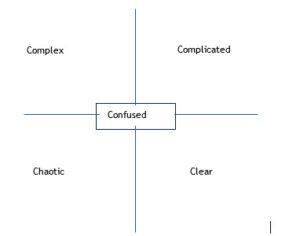
Let us understand the five decision-making contexts with few practical banking examples for each.
1. Clear (Obvious)
Here, the relationship between cause and effect is straightforward. Best practices are known, and outcomes are predictable. Processing a standard cash transaction or updating customer KYC details are some examples in which there is a clear protocol to follow. The response mode suggested is Sense → Categorize → Respond where one has to prioritize efficiency and consistency.
2. Complicated
Cause and effect exist in these cases but are not immediately evident. Expertise, analysis and skilled judgement are required to reach a decision. Some examples can be evaluating a corporate credit proposal or examining risk exposure across portfolios. The response mode for these situations is Sense → Analyze → Respond where leveraging expertise, frameworks, and diagnostic tools are the key.
3. Complex
In this quadrant, cause and effect are only visible in hindsight and the patterns emerge over time and require exploration. Think of launching a new mobile banking facility for a selected section of the customers. Customer adoption, usage trends, and feedback loops are unpredictable here and the response mode best suitable for such cases is Probe → Sense → Respond. Here, one should experiment, observe, and adapt and must be ready for unexpected surprises.
4. Chaotic
No clear relationship exists between cause and effect here. One has to act quickly to stabilize the system. Situations like cyberattacks, system outages, or sudden policy announcements from regulatory bodies that disrupt business as usual are few suitable banking scenarios where the response mode required is Act → Sense → Respond, as per the framework.
5. Aporetic (Confused)
It is when you are unsure which domain the situation belongs to. It may involve multiple elements and lack clarity. Few examples are a newly appointed leader facing a disoriented team, unclear reporting structures, and legacy problem where the suggested response strategy is taking a step back, gathering information and deconstructing the situation into identifiable elements across domains.
Cynefin is not just a classification tool but it is a shift in mindset. While banking traditionally leans toward control and standardization, complex or chaotic environments demand contextual awareness.
The framework urges us to ask:
- Do I really understand what kind of problem this is?
- Should I act, analyze, or experiment?
- Do I need to lead from the front, or create space for solutions to emerge?
This approach promotes humility, adaptability, and inclusiveness— the traits that are crucial for the bankers as their institutions transform at a faster pace.
Key Takeaways for Bankers
Present day banking sector in India is a blend of legacy processes and emerging fintech innovation. We deal with deeply diverse customer segments, evolving technologies, and regulatory shifts that can reshape business overnight.
Cynefin gives us guidance to navigate that complexity. Instead of trying to replace compliance or technical rigor, it complements them by encouraging smart sense-making before action. It helps every professional to ask better questions and choose more appropriate responses. Remember, it is important to
1. Resist the urge to oversimplify. Not every challenge is clear. Avoid applying fixed processes in situations that demand flexibility and nuance.
2. Value expertise. At the same time, embrace experimentation. Complex issues often require safe-to-fail pilots rather than predefined solutions.
3. Act swiftly in times of chaos but be clear about intent. When stability is at risk, speed matters which has to be followed by reflection and recovery.
4. Foster reflective leadership. Encourage teams to pause, assess their environment, and learn from experience rather than rushing to respond.
To bring the Cynefin Framework into daily decision-making, pause and consider:
- What type of environment am I dealing with – clear, complicated, complex, chaotic, or confused?
- Am I going in default to the same approach in every situation, regardless of context?
- Am I clinging to established procedures when discovery or experimentation might serve better?
- Have I taken a moment to sense the dynamics before responding?
- Would a small, low risk experiment help reveal insights before committing to a full solution?
These questions help shift decision making and enables you to move from reflex to reflection, which is an essential shift required in today’s dynamic banking environment.
Conclusion:
The Cynefin Framework is more than a model. For Indian banking professionals, it offers a lens to engage with the world more wisely, especially when challenges seem uncertain or fast moving.
The better we understand the nature of a problem, the better we can choose how to respond. And when we choose our responses wisely, we build systems that are not only more efficient but are more resilient, human, and forward looking.
Authored by:
Gokul Brindhaban GR,
Chief Manager (Research),
Leadership Academy,
Union Bank of India.