
The Future of Cross-Border Payments: Emerging Trends Shaping Global Transactions

Abstract
Cross border payments are the lifeline to global prosperity. The international payments system stands in stark contrast to the domestic payments system in almost all the countries. While domestic payments happen seamlessly in real time with near zero costs, cross border payments can be a nightmare of rules, documents, and costs to a common layman. As per studies carried out at the behest of G-20, the contemporary Correspondent Banking model of cross border payments is fraught with delays, high cost and limited access and transparency. The present paper aims to look at the present model of international payments and evaluate the latest emerging trends and the innovations in the cross-border payments space that attempt to overcome the challenges and transform the future international payments landscape.
Introduction
Imagine a world where everyone has to pay Rs. 6 for every Rs 100 spent on purchasing goods or services. The same Rs 6 is also to be paid if one sends money to a loved one. In the era of digital payments and UPI it sounds outlandish, but this is the world of cross border payments and remittances today.
International payments whether in form of remittances, trade or grants constitute an important pillar of the world economy. As per World Bank’s latest Migration and Development Brief, the global remittance flow in year 2023 was a massive USD 857 Billion with India being the top recipient of global remittances at USD 120 Billion. What is a cause for consternation, however, is the revelation by the Report that the global average cost of cross border remittances was 6.4% in the last quarter of 2023 which is higher than 6.2% a year ago and way above the Sustainable Development Goal of 3%. The rising protectionism and tariff wars is likely to further impact migration, international trade and cross border payments.
The key target of SDG relating to cross border payments is the reduction of inequality within and amongst the countries by 2030 and reducing the transaction costs of migrant remittances to less than 3% and eliminating remittance corridors with costs more than 5%.”
What are cross border payments?
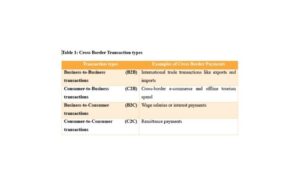
Cross border payments basically refer to transactions where the payer and the payee are located in different countries. These payments may be in form of cross border remittances, international trade transactions like exports and imports, eCommerce payments or investment transfers.
Total global cross border payment flows far exceed the global remittance flows and are expected to be well over USD 150 Trillion and growing at 5% CAGR. It is expected to grow to USD 250 Trillion by 2027.
How do Cross Border Payments work
In international money transfers physical currency is not transferred overseas. Neither can transactions in foreign currency be made through domestic payments system. So, to overcome this peculiar problem, international banks do what is called Correspondent Banking. Under this model, they maintain accounts of foreign banks with them and vice versa. These accounts are known as the Nostro-Vostro accounts. The funds are credited in the Nostro account in one country and corresponding amount is debited in the Nostro account in another jurisdiction. Let us understand the process by way of an example:
Figure 1: Mechanism of Cross Border Payments
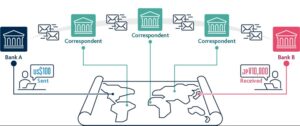
When the sender of money approaches his Bank to initiate the money transfer process, the Bank sends a message through SWIFT (Society for Worldwide Interbank Financial Telecommunication) to debit account with them and credit the account with the receiving Bank. Both the sender’s Bank and the receiver’s Bank charge a fee for the transaction. Additionally, forex charges for currency exchange are also charged.
Often, the sender and receiver’s Banks do not have a direct relationship by way of maintaining accounts with each other. In such cases, they transact with each other through an intermediary known as Correspondent Bank with whom both the Banks maintain their account. There can be multiple Correspondent Banks in the transaction. Each Bank in the chain charges fee for the service rendered. Therefore, the more the number of Correspondent Banks in the chain slower and costlier the process will be. An average cross border payment transaction may take 1-5 business days to settle.
Further, the charges are not same for every pair of currency. The charges are usually lower for freely convertible currency having high volume of payment. Such currency pairs have shorter transaction chains with a smaller number of Banks resulting in lower charges.
Challenges in Cross Border Payments
G-20 Countries had adopted enhancing cross border payments as a priority in the year 2020. An important task towards this end was to identify and address the challenges involved. Some of the most serious challenges encountered in cross border payments are:
1. High costs
While most domestic payments are free, the most commonly used Correspondent Banking model is dependent on multiple layers and Banks at every layer of such transaction charge a fee for processing the payment, thereby adding to the cost. Forex conversion charges, compliance cost etc also contribute to the costs.
2. Slow speed
The domestic Banks in a jurisdiction are connected to a common payments platform which in turn is supervised by the National Regulator. This has given birth to instant or fast payment systems where the payments are made on real time basis. But in cross border payments no such common platform is available and a system with multiple Banks in different geographies invariably leads to much slower settlement of cross border payments. Delays in any part of the end-to-end payment processing slows down the transaction settlement such as search, reconciliation, dispute resolution, AML/KYC checks etc.
3. Lack of transparency
The current cross-border system lack transparency in the sense that there are no real time status updates available and there is limited transparency about costs, speed, rules, system and procedures of different countries. This leads to poor service delivery and lots of heart burn for the users and Payment Service Providers alike.
4. Limited access
International payments are marred by poor accessibility. Cross border transactions require different sets of documents and procedures making it less accessible to common citizens. Access to international payments is often restricted or even denied to several non-Bank players and sometimes entire countries by way of exclusion, sanctions etc. In short, it has limitations in availing services by users and accessing payment system and other related infrastructure by the Payment Service Providers (PSPs)
These four challenges interact with each other, creating newer and more complex challenges such as repeated compliance checks by every jurisdiction, different laws and regulations, legacy technology platforms and weak competition with limited options for end consumers. They thereby confound an already fragmented system by erecting additional barriers to cross border payments.
Emerging trends and solutions in Cross Border payments
With growing emphasis on enhancing cross border payments G-20 came up with a roadmap in 2020 to address the challenges in cross border payments. The G-20 Roadmap targets are:
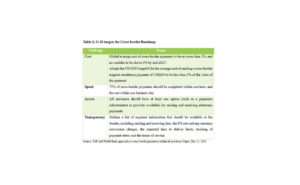
Financial Stability Board (FSB), Bank of International Settlement (BIS) and the Central Banks of several countries have since entered into collaboration for innovations in international payments space. Multiple projects are underway across different themes as per the roadmap. We shall now examine two of the most important emerging solutions in cross border payments.
Cross border instant payments
Instant or fast payments such as UPI, IMPS etc are now deeply enmeshed in the warp and weft of the lives of users of financial services. Consumers want to be able to make payments instantly and in a frictionless manner. This has resulted in a growing clamor for the same experience in case of cross border payments too. Similarly, institutions and firms also want to be able to send and receive payments for their trades just by using their mobile phones and get real time payments.
Growth of digital wallets, mobile banking and the rise of embedded finance where one can make payments through a third-party app without requirement of logging in to one’s Bank internet banking are some of the chief trends. Many fintechs are offering instant cross border payments through their wallets. However, they have issues of their own where it may not be possible to get instant cross border payments unless both the sender and receiver are customers of same entity.
In cross border payments, an important prerequisite is connection and interoperability between the instant payment systems of two different countries. In a fragmented landscape, these systems work on different platforms, follow separate regulations, protocols and designs, and cannot be easily connected. Some of the countries in Southeast Asia like Singapore and Thailand have already interlinked their instant payment systems PayNow and PromptPay respectively. Similarly, India has also interlinked UPI with Singapore’s PayNow. Both of which enable payments based on mobile numbers. However, interlinking with a greater number of countries immediately necessitates creation of a complex platform infrastructure and involves scale related problems.
Under G-20 roadmap, interlinking of instant payment systems (IPS) is a priority to improve the speed, cost, accessibility, and transparency of cross border payments. BIS Innovation Hub at Singapore has been working with Central Banks of Indonesia, Malaysia, Thailand, Philippines, and Singapore on what is called as Project Nexus. This project aims to build on the success of domestic instant payment systems with the potential of bringing down the time taken in cross border payments from few days to less than 60 seconds.
Project nexus follows a standardised multilateral approach. It acts like a hub between different instant payment systems (IPS) where different countries need to invest in infrastructure and resources to be able to connect and communicate with Nexus instead of following the process for each country repeatedly.

Once connected to Nexus, the IPS & the PSPs of member countries will be able to connect to IPS of any other member country without any additional investments or costs.
Both P2P, B2B as well Person to Business and Business to Person payments can be made in Nexus. However, the payment size is dependent on the payment cap set by the domestic IPS so currently Nexus does not support wholesale payments between two institutions and is more likely to be used for relatively smaller payment sizes. Also, as of now only payments in the currency of source and destination IPS can be made involving forex conversion, so cross border payments in same currency or a third currency is not possible.
It is a promising project and in its next live implementation phase, India along with several other Asian countries are going to join Nexus making it a worthy solution to watch out for.
Central Bank Digital Currency (CBDC)
Central Bank Digital Currency or CBDC is the digital money issued by the Central Bank. It is the digital version of a country’s fiat currency. CBDC can be of two broad types viz., Retail and Wholesale CBDCs. Retail CBDC can be used by individuals to make payments to businesses or other individuals. Whereas wholesale CBDCs can be used by institutions to make payments to other institutions. As per 2023 BIS survey on central bank digital currencies (CBDCs) and crypto, 94% of the Central Banks are working on CBDC and almost 31% were in pilot stage. Interestingly, the survey suggests that the Central Banks are exploring wholesale CBDC for enhancing cross border payments and 24% are considering foreign exchange transactions as a potential use case for Wholesale CBDC.
G-20 Roadmap has also identified CBDC as a potential means to improve cross border payments. CBDC are expected to potentially make immediate, cheap, and universally accessible cross border payments a reality. The most promising CBDC based solution for cross border payments is a multi-CBDC platform on which multiple Central Banks can issue and exchange their national CBDCs with other countries. Project Dunbar by BIS Innovation Hub was the first of its kind project that focused on building a common multi CBDC platform and also understanding challenges involved in it.
Project mBridge is a wholesale multi CBDC project by BIS Innovation Hub Hongkong along with the Bank of Thailand, the Central Bank of the United Arab Emirates, the Digital Currency Institute of the People’s Bank of China, and the Hong Kong Monetary Authority. It has over 31 observer members including Reserve Bank of India, Federal Reserve Bank of New York, IMF, World Bank etc.
Multi CBDC platform mBridge is based on Blockchain and distributed ledger technology. It has its own custom built blockchain mBridge ledger which has been developed by Central Banks for Central Banks. It allows real time, peer to peer foreign exchange and cross border payments. Being a common single platform with single standard or rules, protocols, and architecture, it overcomes the interoperability issue and starts with a clean slate where all the Central Banks can issue and exchange their CBDCs. The platform is designed to connect different jurisdictions in a common technical infrastructure.
The platform also enables smart contracts execution and enables straight through processing and atomic settlements. Atomic settlement means there is no distinction between the money and message and all parts of the transaction either happen together or do not happen at all. Take the example of modern correspondent Baking where message travels by SWIFT and money travels through chains of correspondent banks and both travel at different time and speeds, thereby resulting in both reaching the recipient separately and at different times. In mBridge ledger the transaction happens in form of digital currency or CBDC and there is no need for a separate message by SWIFT or any other similar intermediary. Project mBridge has reached the minimum viable product or MVP stage in June 2024 thereby taking it forward from prototype stage and closer to production ready stage.
The platform design aims to ensure that mBridge adheres to the five main CBDC principles as enunciated in G-20 Roadmap viz., do no harm, enhancing efficiency, improving resilience, assuring coexistence and interoperability with non-CBDC systems, and enhancing financial inclusion.
The project mBridge is at the cutting edge of innovation in international payments and may well prove to be the proverbial holy grail of cross border payments.
Conclusion
Cross border payment is the arterial system of global economy supplying lifeblood across the vast and sometimes treacherous routes connecting countries and economies in an intricate web of interdependent linkages. Just like an arterial blockage causes reduced supply of oxygen to that part of body or even a heart attack, an anaemic international payments system that does not reach intended destination at intended time leads to less-than-optimal outcomes. It may even result in complete breakdown of politico-economic model on the bedrock of which grow not only global trade but also international relations. The present system of international payments is in dire need of transformation. There are many international collaborative projects underway in this direction under the aegis of multilateral bodies such as G-20. However, the success of all these models will depend on how they respond to governance, legality, and privacy related concerns. These are times of rapid changes and only time will tell which model comes out on top, but these are exciting times for banking and payments industry, nonetheless.
Authored by:
Neha Upadhyaya
Chief Manager (Faculty)
State Bank Foundation Institute ‘Chetana’
Indore