
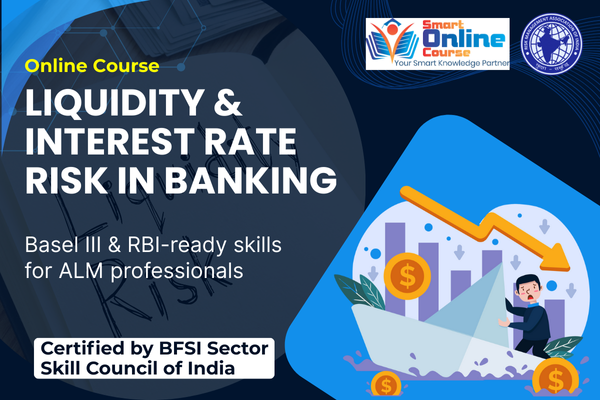
Online Certificate Course on Liquidity & Interest Rate Risk in Banking
Liquidity risk and interest rate risk in the banking book are two of the most important balance-sheet risks faced by banks.
A bank must be able to meet its funding obligations while also managing the impact of interest rate movements on earnings, economic value, and profitability. Weak liquidity planning or poor interest rate risk management can create serious financial stress.
The Online Certificate Course on Liquidity & Interest Rate Risk in Banking is designed to help professionals understand how these risks are measured, monitored, governed, and managed.
The programme provides approximately 9 hours of self-paced learning with 120 days of access and covers liquidity risk, LCR, NSFR, IRRBB, RBI and BCBS guidance, stress testing, early warning indicators, ALM, and global case studies.
Why Liquidity & Interest Rate Risk Matter
Banks operate by transforming short-term and long-term funding into loans, investments, and other assets. This makes balance-sheet management a critical discipline.
Liquidity risk can arise when a bank is unable to meet payment or funding obligations without incurring excessive cost or losses.
Interest rate risk in the banking book can arise when changes in interest rates affect:
- Net interest income
- Economic value
- Asset yields
- Funding costs
- Repricing gaps
- Balance-sheet sensitivity
Strong risk management therefore requires banks to understand both funding stability and interest rate exposure.
This course helps learners develop that integrated perspective.
About the Course
The Liquidity & Interest Rate Risk in Banking course provides a structured understanding of liquidity management and IRRBB from both regulatory and practical perspectives.
The programme begins with the foundations of liquidity and interest rate risk, then moves into the two major liquidity metrics: Liquidity Coverage Ratio (LCR) and Net Stable Funding Ratio (NSFR).
Learners then explore IRRBB, regulatory expectations, stress testing, early warning indicators, and Asset Liability Management practices.
The course also includes global case studies and best practices to help participants connect theory with real banking situations.
What Will You Learn?
By completing the programme, learners will develop a stronger understanding of:
- Liquidity risk fundamentals
- Interest rate risk in the banking book
- Liquidity Coverage Ratio
- Net Stable Funding Ratio
- Funding stability
- Repricing risk
- Earnings sensitivity
- RBI and BCBS guidance
- Stress testing
- Early warning indicators
- Asset Liability Management
- Balance-sheet risk management
- Global case studies and best practices
The objective is to help learners understand how liquidity and interest rate risks interact with profitability, funding, and overall bank resilience.
Course Curriculum
The programme includes seven focused modules.
Module 1: Foundations of Liquidity & IRRBB Risks
This module introduces the basic concepts behind liquidity risk and interest rate risk in the banking book.
Learners understand how funding mismatches, repricing gaps, market movements, and balance-sheet structure can influence risk exposure.
Module 2: Liquidity Coverage Ratio (LCR)
The LCR is a key regulatory liquidity metric.
This module explains the purpose of the ratio and how it relates to high-quality liquid assets and short-term liquidity stress.
Learners develop an understanding of how LCR is calculated and interpreted in the context of a bank’s ability to withstand short-term funding pressure.
Module 3: Net Stable Funding Ratio (NSFR)
While LCR focuses on shorter-term liquidity, NSFR addresses longer-term funding stability.
This module explains how banks assess the relationship between available stable funding and required stable funding.
Learners understand why stable funding structures are important for reducing long-term liquidity risk.
Module 4: Interest Rate Risk in the Banking Book (IRRBB)
This module focuses on how changes in interest rates can affect the banking book.
Learners explore:
- Repricing risk
- Yield-curve risk
- Basis risk
- Optionality
- Earnings impact
- Economic value impact
The module helps participants understand how rate movements can influence both profitability and balance-sheet value.
Module 5: RBI & BCBS Guidelines on Liquidity & IRRBB
Liquidity and IRRBB are closely linked to regulatory expectations.
This module provides an overview of relevant guidance from the Reserve Bank of India and Basel Committee on Banking Supervision.
The focus is on helping learners understand how regulatory principles translate into governance, measurement, monitoring, and reporting requirements.
Module 6: Stress Testing, Early Warning & ALM Practices
Banks need to understand how risk could behave under adverse conditions.
This module covers:
- Liquidity stress testing
- Interest rate stress scenarios
- Early warning indicators
- Gap analysis
- ALM monitoring
- Escalation and governance
The objective is to help learners understand how proactive monitoring can support stronger balance-sheet risk management.
Module 7: Global Case Studies & Best Practices
The final module uses case-based learning to examine how liquidity and interest rate risk can become significant during periods of market stress.
Learners explore practical lessons and compare risk-management approaches used across institutions and markets.
Who Should Enroll?
The course is particularly relevant for:
- Banking professionals
- Treasury professionals
- ALM professionals
- Risk management teams
- Finance teams
- Balance-sheet management professionals
- Internal auditors
- Compliance professionals
- Chartered accountants
- Financial analysts
- Banking risk students
- BFSI professionals
It can also be useful for professionals preparing to move into treasury, ALM, liquidity-risk, or market-risk-related roles.
Key Skills You Can Develop
The programme can help strengthen your understanding of:
- Liquidity risk measurement
- LCR
- NSFR
- IRRBB
- Repricing analysis
- Earnings sensitivity
- Economic value analysis
- Regulatory interpretation
- Stress testing
- Early warning indicators
- ALM practices
- Balance-sheet risk management
These capabilities are relevant across treasury, finance, risk, audit, ALM, and senior management functions.
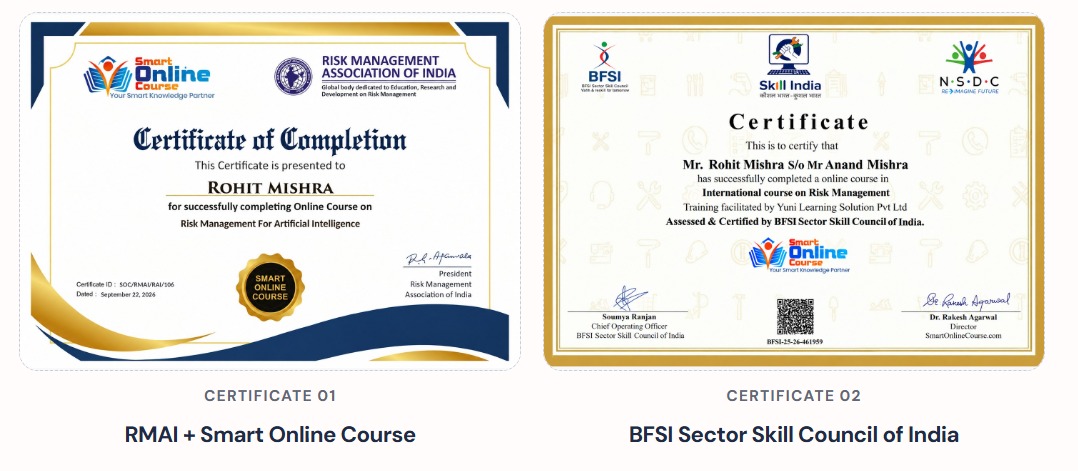 Course Highlights
Course: Liquidity & Interest Rate Risk in Banking
Duration: 9 Hours
Access Validity: 120 Days
Mode: Self-Paced Online Learning
Learning Method: Practical + Case Study-Based
Level: Intermediate to Advanced
Focus: Liquidity Risk, IRRBB, LCR, NSFR & ALM
The programme is designed for learners who want a focused and regulatory-aligned understanding of balance-sheet risk.
Career Relevance
Knowledge of liquidity and interest rate risk can support roles such as:
- Liquidity Risk Analyst
- ALM Analyst
- Treasury Professional
- Balance-Sheet Risk Analyst
- Market Risk Professional
- Banking Risk Manager
- Finance Professional
- Internal Auditor
- Regulatory Risk Analyst
- Risk Reporting Professional
For students and early-career professionals, the course can provide structured exposure to an advanced area of banking risk management.
Interested in the Liquidity & Interest Rate Risk Course?
If you want to strengthen your understanding of LCR, NSFR, IRRBB, stress testing, and ALM, this programme provides a focused learning pathway.
Request Course Information
Want details about the fee, certification, examination, or course suitability?
Complete the study enquiry form
Speak to Our Team on WhatsApp
Have questions about the programme or want guidance before enrolling?
Sales / Course Enquiry
Mobile number: 82320 83010
Email: info@smartonlinecourse.org
Frequently Asked Questions
Q. What is the duration of the course?
The programme includes approximately 9 hours of learning.
Q. How long is course access available?
Learners receive 120 days of access.
Q. Does the course cover LCR and NSFR?
Yes. Separate modules cover both liquidity metrics.
Q. Does the course include IRRBB?
Yes. A dedicated module covers Interest Rate Risk in the Banking Book.
Q. Are RBI and BCBS guidelines included?
Yes. The course includes a focused module on relevant RBI and Basel Committee guidance.
Q. Does the course cover stress testing and ALM?
Yes. Stress testing, early warning indicators, and Asset Liability Management practices are covered in detail.
Build Stronger Balance-Sheet Risk Management Skills
Liquidity and interest rate risk management requires professionals to understand the interaction between funding, asset-liability structure, regulatory metrics, market movements, and profitability.
The Online Certificate Course on Liquidity & Interest Rate Risk in Banking brings these areas together in a focused 9-hour self-paced programme with 120 days of access.
Explore the course, submit an enquiry, or speak with the course team to know more.