
Online Certificate Course on Fraud Risk Management in Banking
Fraud remains one of the most significant risks faced by banks and financial institutions.
As digital banking, online payments, mobile transactions, and technology-enabled financial services expand, fraud techniques are also becoming more sophisticated. Banks therefore need professionals who can identify suspicious activity, review alerts, investigate transactions, preserve evidence, understand control failures, and strengthen fraud governance.
The Online Certificate Course on Fraud Risk Management in Banking is designed to provide practical knowledge of fraud prevention, transaction monitoring, investigation, escalation, control improvement, and governance oversight.
The programme offers approximately 7 hours of self-paced learning with 120 days of access and uses a practical, case-study-based approach focused on real banking scenarios.
Why Fraud Risk Management Matters Today
Fraud can create financial, operational, regulatory, and reputational consequences for banks.
Fraud risk may arise through:
- Suspicious transactions
- Digital payment abuse
- Identity misuse
- Internal control failures
- Process manipulation
- Weak monitoring systems
- Inadequate escalation
- Poor evidence management
- Behavioural and operational gaps
Effective fraud risk management therefore requires more than identifying a fraudulent transaction after it occurs.
Banks need structured processes for detection, investigation, escalation, root-cause analysis, preventive controls, and governance oversight.
Professionals who understand these areas can contribute to a stronger fraud-control environment across banking operations.
About the Course
The Fraud Risk Management in Banking course provides a structured understanding of how fraud risks are identified, investigated, escalated, and controlled.
The programme begins with the fraud landscape and transaction monitoring before moving into alert review, investigative analysis, evidence integrity, escalation protocols, control failures, root causes, and preventive controls.
It also focuses on governance oversight, helping learners understand how institutions can strengthen their overall fraud risk management framework.
The objective is to give learners practical knowledge that can be applied across banking, financial crime, compliance, internal audit, operational risk, and transaction-monitoring functions.
What Will You Learn?
By completing the programme, learners will develop a stronger understanding of:
- The evolving fraud landscape in banking
- Transaction-monitoring logic
- Alert review processes
- Investigative analysis
- Escalation protocols
- Evidence preservation
- Fraud control failures
- Behavioural and process gaps
- Root-cause analysis
- Preventive controls
- Governance oversight
- Fraud risk management frameworks
The focus is on helping participants understand the complete fraud-management process rather than looking at isolated fraud cases.
Course Curriculum
The programme includes an introduction to risk management followed by five focused modules.
Introduction to Risk Management
The course begins with basic risk management concepts to help learners understand how fraud fits within the broader operational and financial risk environment of a bank.
Module 1: Fraud Landscape & Transaction Monitoring Logic
This module introduces the changing nature of fraud in banking and explains how transaction-monitoring systems help identify unusual or suspicious activity.
Learners develop an understanding of how monitoring rules, patterns, thresholds, and alerts can support fraud detection.
Module 2: Alert Review Workflow & Investigative Analysis
Generating an alert is only the first step.
This module explains how alerts are reviewed, prioritised, analysed, and investigated.
Learners explore how to evaluate transaction behaviour, gather information, identify anomalies, and determine whether escalation is required.
Module 3: Escalation Discipline & Evidence Integrity
Fraud investigations require structured escalation and reliable evidence.
This module focuses on escalation protocols, documentation, evidence handling, and the importance of maintaining integrity throughout the investigative process.
It helps learners understand why poorly documented investigations can weaken fraud-control effectiveness.
Module 4: Control Failures, Behavioural Gaps & Root Causes
Fraud incidents often reveal deeper weaknesses in processes, systems, supervision, or employee behaviour.
This module examines how to identify control failures and behavioural gaps and how root-cause analysis can help institutions understand why fraud occurred.
The focus is on learning from incidents rather than simply closing individual cases.
Module 5: Strengthening Preventive Controls & Governance Oversight
The final module focuses on prevention.
Learners explore how banks can strengthen controls, improve monitoring, enhance accountability, and establish stronger governance oversight.
The module helps connect investigation findings with long-term control improvement.
Who Should Enrol?
The course is particularly relevant for:
- Banking professionals
- Fraud risk management teams
- Compliance officers
- Operational risk professionals
- Internal auditors
- AML and financial crime professionals
- Transaction-monitoring analysts
- Branch managers
- Banking operations teams
- Digital banking professionals
- Risk management professionals
- MBA Finance students
- BFSI aspirants
It can also be useful for professionals who want to move into fraud risk, compliance, financial crime, or operational-risk roles.
Key Skills You Can Develop
The programme can help strengthen your understanding of:
- Fraud risk identification
- Transaction monitoring
- Alert investigation
- Investigative workflows
- Evidence management
- Escalation processes
- Root-cause analysis
- Control testing
- Preventive controls
- Fraud governance
- Operational-risk awareness
- Financial crime investigation
These skills are relevant across banks, NBFCs, payment organisations, financial institutions, and other BFSI businesses.
 Course Highlights
Course: Fraud Risk Management in Banking
Duration: 7 Hours
Access Validity: 120 Days / 4 Months
Mode: Self-Paced Online Learning
Learning Method: Practical + Case Study-Based
Focus: Fraud Detection, Investigation, Controls & Governance
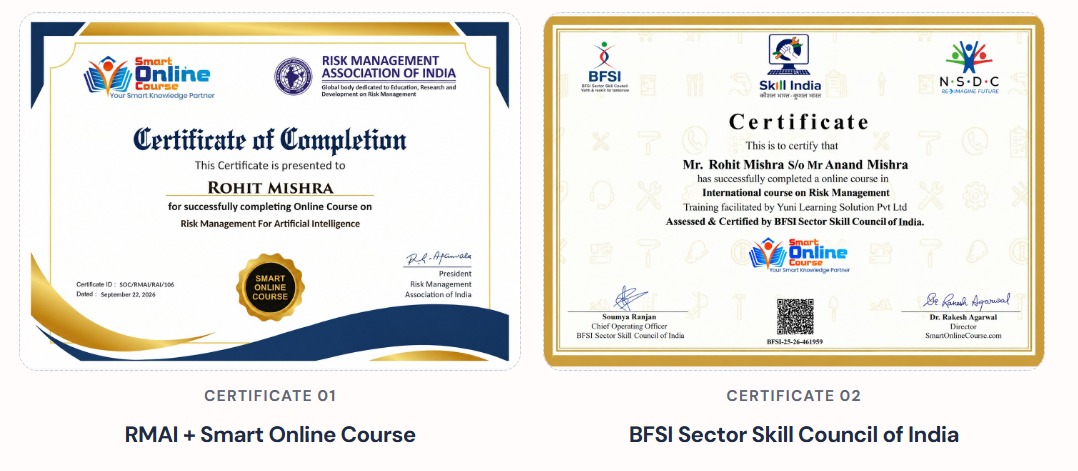
Certification: Dual Certification
External Examination: BFSI Sector Skill Council of India
The compact programme is designed for professionals who want practical fraud-risk knowledge without committing to a long-duration course.
Career Relevance
Fraud risk knowledge can be useful across roles such as:
- Fraud Risk Analyst
- Transaction Monitoring Analyst
- Financial Crime Analyst
- Compliance Professional
- Operational Risk Analyst
- Internal Auditor
- Fraud Investigator
- Banking Operations Professional
- Digital Banking Risk Professional
- Risk and Control Specialist
For students and early-career professionals, the course can also provide useful exposure to one of the most important risk functions within banking.
Interested in the Fraud Risk Management Course?
If you want to strengthen your understanding of fraud detection, transaction monitoring, investigation, evidence management, control failures, and governance, this programme provides a structured learning pathway.
Request Course Information
Want details about the course fee, certification, examination, or enrolment process?
Complete the study enquiry form
Speak to Our Team on WhatsApp
Have questions about the course or want guidance before enrolling?
Sales / Course Enquiry
Mobile number: 82320 83010
Email: info@smartonlinecourse.org
Frequently Asked Questions
What is the duration of the course?
The programme includes approximately 7 hours of learning.
How long is course access available?
Learners receive 120 days / 4 months of access.
Does the course cover transaction monitoring?
Yes. Transaction-monitoring logic and alert identification are covered in the first module.
Does it include fraud investigation?
Yes. The programme covers alert review, investigative analysis, escalation, and evidence integrity.
Are control failures and root causes covered?
Yes. A dedicated module examines control weaknesses, behavioural gaps, and root-cause analysis.
Is there an external certification examination?
Yes. The programme includes an external certification examination conducted by the BFSI Sector Skill Council of India.
Build Practical Fraud Risk Management Skills
Fraud risk management requires professionals to understand the complete chain from detection and investigation to escalation, root-cause analysis, prevention, and governance.
The Online Certificate Course on Fraud Risk Management in Banking brings these areas together in a focused 7-hour self-paced programme with 120 days of access.
Explore the course, submit an enquiry, or speak with the course team to know more.