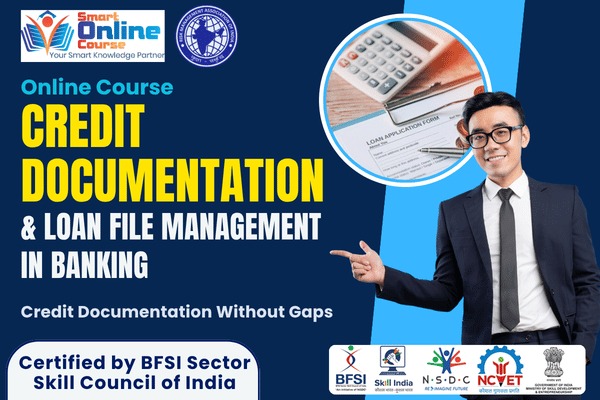
Online Certificate Course on Credit Documentation & Loan File Management in Banking
Credit documentation is one of the most important foundations of sound lending.
A loan may be properly assessed and sanctioned, but weaknesses in documentation, security creation, compliance tracking, disbursement controls, or post-disbursement records can expose a bank to significant credit, legal, operational, and audit risks.
The Online Certificate Course on Credit Documentation & Loan File Management in Banking is designed to help banking professionals develop a practical understanding of the complete loan documentation lifecycle.
The programme provides approximately 6 hours of self-paced learning with 120 days of access and focuses on sanction documentation, collateral records, disbursement controls, monitoring, audit readiness, early warning signals, and practical documentation failures.
Why Credit Documentation Matters Today
Credit documentation is not simply an administrative activity. It plays a critical role in protecting the lender’s interests throughout the life of a loan.
Weak or incomplete documentation may create problems relating to:
- Enforceability of loan terms
- Compliance with sanction conditions
- Creation and perfection of security
- Disbursement control
- Insurance and collateral records
- Monitoring of borrower obligations
- Audit observations
- Recovery and legal proceedings
- Regulatory compliance
- Accountability within the lending process
Banks therefore require disciplined documentation practices from the time a credit facility is sanctioned until it is fully repaid or closed.
Professionals involved in lending need to understand not only which documents are required, but also when they are required, how they should be tracked, and what risks arise when documentation is incomplete or defective.
About the Course
The Credit Documentation & Loan File Management in Banking course provides a structured understanding of how loan documentation should be organised, monitored, verified, and maintained.
The programme begins with the overall loan documentation lifecycle and file structure before moving into sanction conditions, collateral and security documents, insurance records, disbursement controls, post-disbursement monitoring, early warning signals, audit observations, and practical failure scenarios.
The course focuses on the discipline required to maintain a complete and defensible credit file.
It is particularly relevant for professionals working across credit, loan operations, documentation, relationship management, underwriting, compliance, internal audit, and risk functions.
What Will You Learn?
By completing the programme, learners will develop a stronger understanding of:
- Loan documentation structures and workflows
- Credit file organisation
- Sanction documentation
- Tracking of sanction conditions
- Collateral and security documentation
- Insurance documentation
- Pre-disbursement requirements
- Disbursement controls
- Checklist discipline
- Post-disbursement monitoring
- Documentation-linked early warning signals
- Audit readiness
- File defensibility
- Common documentation failures
The course is designed to connect documentation with the broader credit-risk management process rather than treating loan files as a purely operational requirement.
Course Curriculum
The programme covers eight focused modules dealing with the complete documentation and loan-file management lifecycle.
Module 1: Loan Documentation Lifecycle & File Structure
This module introduces the complete loan documentation process and explains how a properly maintained loan file should be structured.
Learners understand how documents move through different stages of the lending lifecycle and why systematic file organisation is essential for control, monitoring, and audit readiness.
Module 2: Sanction Documentation & Condition Tracking
Every credit sanction is subject to specific terms, conditions, approvals, and documentation requirements.
This module explains how sanction conditions should be recorded, monitored, and tracked before and after disbursement.
Learners also understand the risks that arise when conditions are overlooked, delayed, or inadequately documented.
Module 3: Collateral, Security & Insurance Documentation
Security documentation is a critical part of protecting the lender’s interests.
This module covers documentation relating to collateral, securities, guarantees, charges, and insurance.
The focus is on ensuring that required records are complete, current, traceable, and aligned with the terms of the sanctioned facility.
Module 4: Disbursement Controls & Checklist Discipline
Loan disbursement should occur only after required conditions and documentation have been properly completed.
This module explains the importance of pre-disbursement verification, documentation checklists, approvals, exceptions, and control discipline.
Learners understand how structured checklists can reduce operational errors and prevent premature or non-compliant disbursement.
Module 5: Post-Disbursement Monitoring & Documentation
Documentation responsibilities continue after funds are released.
This module focuses on maintaining updated records, tracking pending documents, monitoring borrower commitments, and ensuring that the credit file reflects ongoing developments in the account.
It helps learners understand how documentation supports effective credit monitoring throughout the loan lifecycle.
Module 6: Early Warning Signals & Documentation Linkage
Loan files can often reveal signs of emerging borrower stress.
This module explains how delays, missing records, repeated exceptions, changes in collateral information, insurance gaps, or unfulfilled conditions may indicate increasing credit risk.
Learners understand how documentation can support the identification and escalation of early warning signals.
Module 7: Audit Observations & File Defensibility
Internal auditors, regulators, and inspection teams frequently review credit files to assess whether lending decisions and controls are properly supported.
This module explains common documentation-related audit observations and how banks can improve file defensibility.
The objective is to help learners understand what makes a credit file complete, traceable, and capable of withstanding review.
Module 8: Case Patterns & Practical Failure Scenarios
The final module brings together the concepts covered throughout the course.
Learners examine practical situations involving missing documents, incomplete compliance, weak monitoring, defective security records, or poor file maintenance.
The focus is on understanding how documentation failures occur and how they can be prevented through stronger process discipline.
Who Should Enroll?
The course is particularly relevant for:
- Banking professionals
- Credit officers
- Credit analysts
- Loan processing teams
- Loan documentation teams
- Relationship managers
- Underwriting professionals
- Branch managers
- Credit operations professionals
- Internal auditors
- Compliance professionals
- Risk management teams
- Freshers aspiring to enter banking credit roles
- MBA Finance and banking students
It can also be useful for professionals who want to move into credit administration, documentation, underwriting, audit, or lending operations.
Key Skills You Can Develop
The programme can help strengthen your understanding of:
- Credit documentation management
- Loan file structuring
- Sanction condition tracking
- Security documentation
- Collateral records
- Insurance documentation
- Pre-disbursement verification
- Disbursement controls
- Post-disbursement monitoring
- Documentation-based risk identification
- Audit preparation
- Documentation exception management
- Credit file defensibility
These capabilities are relevant across banks, NBFCs, housing finance companies, lending institutions, and other credit-oriented financial businesses.
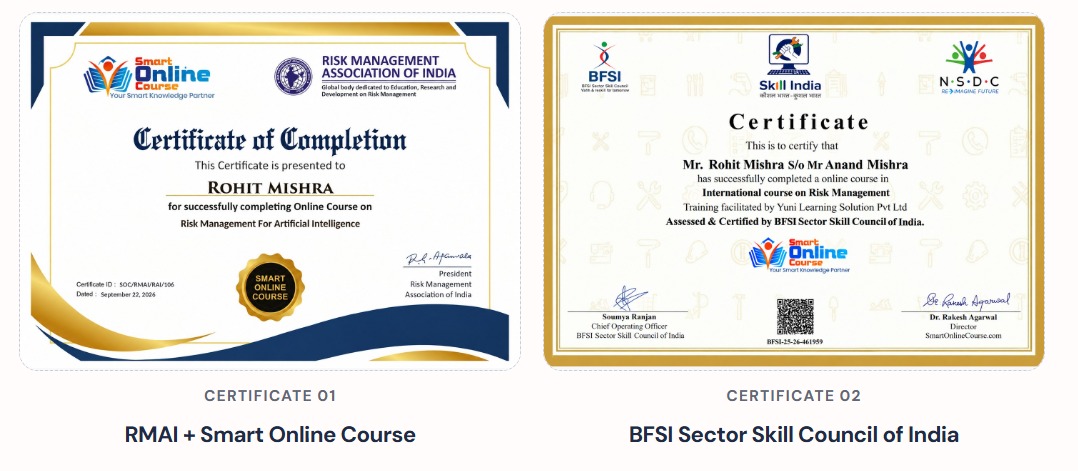 Course Highlights
Course: Credit Documentation & Loan File Management in Banking
Duration: 6 Hours
Access Validity: 120 Days / 4 Months
Mode: Self-Paced Online Learning
Learning Method: Practical + Case Study-Based
Level: Beginner to Advanced
Focus: Documentation, Loan Files, Security, Disbursement & Audit Readiness
The programme is designed for professionals who want focused and practical knowledge of credit documentation without committing to a long-duration programme.
Career Relevance
Knowledge of credit documentation can support professionals working in roles such as:
- Credit Officer
- Credit Analyst
- Loan Documentation Officer
- Credit Operations Professional
- Loan Processing Officer
- Relationship Manager
- Underwriting Professional
- Credit Administration Officer
- Internal Auditor
- Risk and Control Professional
- Banking Operations Professional
- Compliance Professional
For students and early-career professionals, the course can also provide exposure to an important area of the lending process that connects credit appraisal, operations, risk control, monitoring, and audit.
Interested in the Credit Documentation & Loan File Management Course?
If you want to strengthen your understanding of loan documentation, sanction conditions, collateral records, disbursement controls, monitoring, and audit readiness, this programme provides a structured learning pathway.
Request Course Information
Want details about the fee, certification, examination, or course suitability?
Complete the study enquiry form
Speak to Our Team on WhatsApp
Have questions about the programme or want guidance before enrolling?
Sales / Course Enquiry
Mobile number: 82320 83010
Email: info@smartonlinecourse.org
Frequently Asked Questions
Q. What is the duration of the course?
The programme includes approximately 6 hours of self-paced learning.
Q. How long is course access available?
Learners receive 120 days / 4 months of access.
Q. Does the course cover sanction documentation?
Yes. A dedicated module focuses on sanction documentation and tracking of sanction conditions.
Q. Does the course include collateral and security documentation?
Yes. The programme covers collateral, security, and insurance-related documentation.
Q. Does it cover disbursement controls?
Yes. Learners study pre-disbursement requirements, checklist discipline, approvals, and documentation controls.
Q. Is post-disbursement monitoring included?
Yes. The course covers ongoing documentation requirements and post-disbursement monitoring.
Q. Does the course cover audit observations?
Yes. A dedicated module focuses on common audit observations and strengthening loan-file defensibility.
Build Stronger Credit Documentation and Loan File Management Skills
Sound lending requires more than a good credit decision. It also requires accurate documentation, disciplined compliance tracking, strong disbursement controls, effective monitoring, and complete records throughout the loan lifecycle.
The Online Certificate Course on Credit Documentation & Loan File Management in Banking brings these areas together in a focused 6-hour self-paced programme with 120 days of access.
Explore the course, submit the study enquiry form, or speak with the course team to understand how the programme can support your professional learning.