

India’s Big Bank Merger 2.0

India stands at a defining juncture in its banking journey. As the economy accelerates towards the ambitious $5 trillion target, the demand for robust, well-capitalised, and globally competitive banks has never been more pressing. Public Sector Banks (PSBs), which still account for over 70% of India’s banking system, face the dual challenge of supporting mega infrastructure projects while also catering to financial inclusion and MSME credit needs.
Against this backdrop, the Government is considering another wave of consolidation – aptly termed as PSB Consolidation 2.0 – to create fewer but stronger lenders capable of competing with global giants and financing India’s growth story. As part of the Viksit Bharat roadmap, India aims to position two public sector banks among the world’s top 20 by 2047.
This renewed phase of proposed consolidation is not only about scale but also about structural transformation. Presently, the banking landscape is undergoing disruption from fintechs, digital-first private players, and changing consumer expectations. To remain relevant and efficient, PSBs must build deeper technological capabilities, improve governance, and ensure financial sustainability. Consolidation offers a pathway to pool resources and drive this transformation.
Furthermore, India’s credit-to-GDP ratio still lags behind global benchmarks of around 130% – 150% of GDP. As of 2025, India’s domestic credit to the private sector stood at approximately 93.3% of GDP, significantly below the world average of 130 % -150% and much lower than its Asian peers like China (201.9%) and South Korea (200.8%) [Source: BIS Report]. This disparity underscores the need for larger and healthier banks to expand credit penetration, especially in rural and semi-urban markets, while simultaneously handling the demands of large-scale infrastructure and industrial financing. Without consolidation, PSBs risk fragmentation and limited competitiveness. while simultaneously handling the demands of large-scale infrastructure and industrial financing. Additionally, as China, the US and Europe continue to strengthen their banking giants, India cannot afford to be left behind with mid-sized, fragmented banks.
In essence, Merger 2.0 is not just an economic exercise; it is a strategic imperative for ensuring financial stability, advancing India’s development goals and positioning the country’s banking system as a formidable global player in the decades ahead.
2. Historical Context: The Genesis of Indian Bank Consolidation
2.1 Nationalisation of Banks (1969 & 1980)
Bank consolidation in India began with the nationalisation waves of 1969 and 1980, when the government took over major private banks to expand state control and promote financial inclusion. The 1969 initiative led by Prime Minister Indira Gandhi brought 14 large banks under public ownership, followed by six more in 1980. These moves widened banking access in rural and semi-urban areas and redirected credit towards agriculture, small industries, and rural development. Nationalisation transformed banks into instruments of national development rather than purely commercial entities.
2.2 Early Reform Committees
By the 1990s, excessive state control had led to inefficiency, rising NPAs, and weak governance in banks. To address these issues, the Government set up the Narasimham Committees, which advocated a tiered banking structure with global, national, and regional banks, emphasising autonomy, capital adequacy, and prudential norms. Later, the PG Nair Committee (2014) reinforced the need for governance reforms and consolidation to strengthen PSBs, improve capital efficiency, and enhance competitiveness in a digital and globalised environment.
2.3 Long-Term Impact
These reform milestones created the intellectual and policy groundwork for structured consolidation in Indian banking. They established the logic that scale, efficiency, and governance reform were interconnected goals. Nationalisation had ensured inclusion, but it was consolidation and reform that promised competitiveness. Over time, this thinking shaped subsequent waves of mergers, such as the SBI associate banks merger and the 2020 PSB consolidation exercise, marking a shift from banks as social institutions to banks as engines of global competitiveness.
3. The First Waves of Consolidation
3.1 SBI and Associate Banks Merger (2017)
A landmark consolidation occurred in 2017, when the State Bank of India (SBI) merged with its five associate banks—State Bank of Bikaner & Jaipur, State Bank of Patiala, State Bank of Hyderabad, State Bank of Travancore, State Bank of Mysore and the Bharatiya Mahila Bank. It elevated SBI among the world’s top 50 banks, expanding its scale, reach, and market share. The merger showcased the benefits of size in capital strength and project financing, while also revealing transitional challenges in customer service and HR integration.
3.2 Vijaya Bank–Dena Bank–Bank of Baroda (2019)
In 2019, the government initiated another bold step by merging Vijaya Bank and Dena Bank with Bank of Baroda (BoB). This move created India’s third-largest bank and marked the first time three mid-sized PSBs were combined.
Bank of Baroda Performance Comparison – 2019 vs 2025
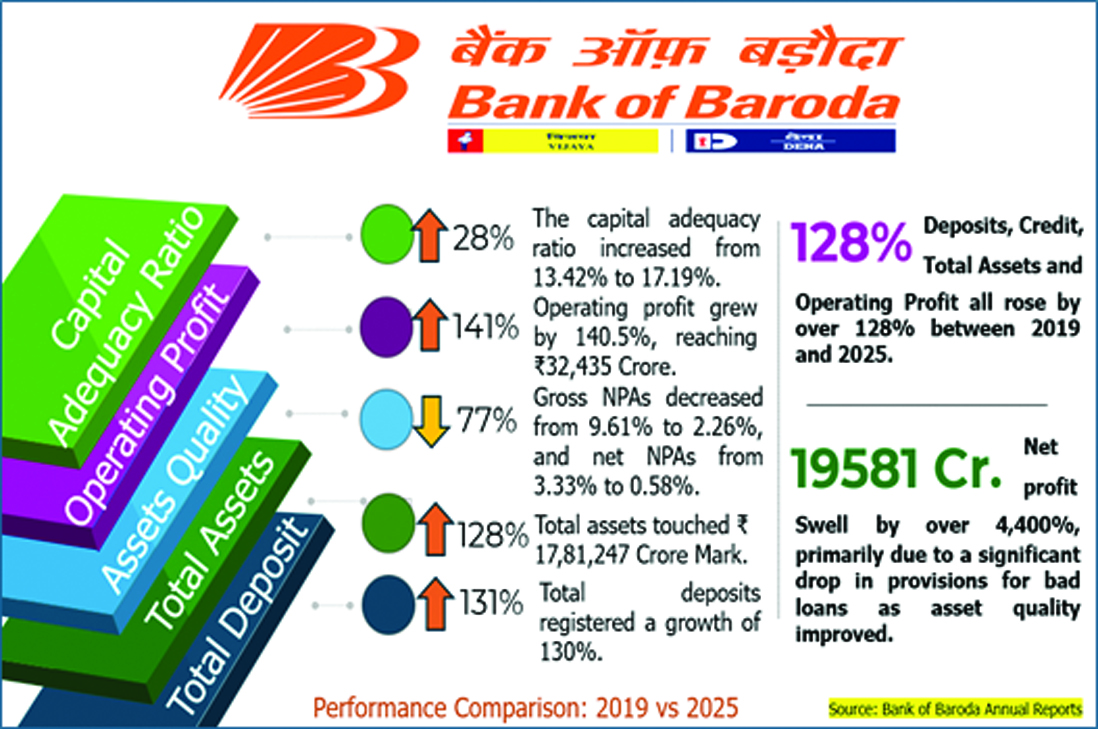
- Exceptional Profitability: Net Profit soared by an impressive 4,418%.
- Strong Balance Sheet Growth: Deposits grew by 131%, Advances by 163%, and Total Assets by 128%, reaching ₹14.72 lakh crore, ₹12.30 lakh crore, and ₹17.81 lakh crore respectively.
- Significant Improvement in Asset Quality: Gross NPAs came down from 9.61% to 2.26% and net NPAs from 3.33% to 0.58%. This sharp improvement shows the success of recovery drives, better loan monitoring and stronger credit appraisal, which together helped boost the Bank’s profitability.
- Strengthened Capital Base: The Capital Ratio improved by 28.1 percentage points, with the overall Capital Adequacy Ratio rising from 13.42% to 17.19%, comfortably above the regulatory requirement, reflecting the Bank’s strong financial resilience.
Post-merger, Bank of Baroda witnessed transformational results as it successfully transitioned from a bank with moderate growth and significant asset quality concerns to a stronger, more resilient institution with improved profitability, reduced non-performing assets and enhanced operational efficiency, positioning itself for sustainable long-term growth.
The consolidation showcased the feasibility of merging institutions with varied financial health—while Vijaya Bank was relatively stronger, Dena Bank had been under the RBI’s Prompt Corrective Action (PCA) framework. The merger demonstrated how stronger banks could absorb weaker ones, thereby stabilising the overall system.
3.3 The Big Merger of 2020
In April 2020, India witnessed its largest banking consolidation, reducing 27 public sector banks (PSBs) to 12. Punjab National Bank absorbed Oriental Bank of Commerce and United Bank of India; Canara Bank merged with Syndicate Bank; Union Bank of India took over Andhra Bank and Corporation Bank; and Indian Bank merged with Allahabad Bank.
Taking Punjab National Bank (PNB) as an example, the financial performance between 2020 and 2025 reflects substantial growth across key parameters, demonstrating the intended benefits of consolidation:
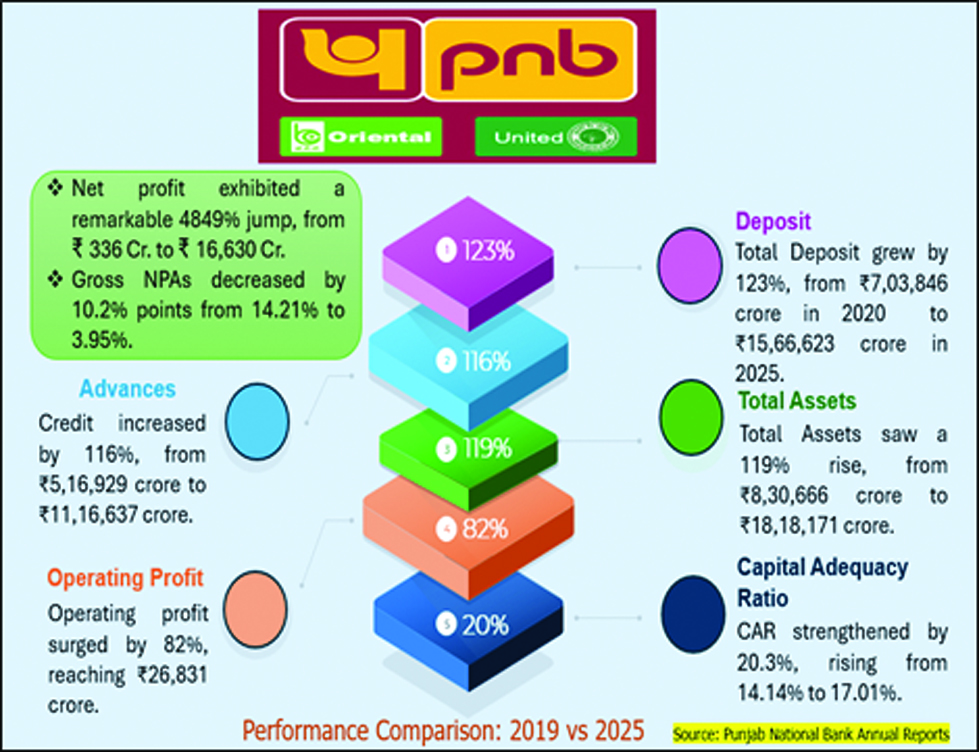
The data analysis shows that –
- Total Assets are expected to grow by 119%, reflecting a strong expansion in business scale.
- Operating Profit is projected to rise by 82%, showing better efficiency and stronger core operations.
- Net Profit may jump by over 4,800%, moving from fragile to robust levels, mainly due to a sharp fall in bad-loan provisions.
- Gross NPAs are set to drop by 72% (from 14.21% to 3.95%), while Net NPAs could fall by 93% to just 0.40%, indicating a clean and well-managed loan book.
- Capital Adequacy Ratio is likely to strengthen from 14.14% to 17.01%, providing solid capital strength for future growth.
The comparison indicates a successful strategic shift from post-crisis stabilization (2020) to confident, profitable growth (2025), positioning PNB as a strong and systemically important bank in the Indian banking landscape.
The 2020 restructuring of ten PSBs aimed to build stronger, more efficient institutions by reducing overlap and improving cost efficiency. The mergers sought to achieve economies of scale, ease the government’s recapitalisation burden, and enhance lending capacity to key sectors like infrastructure and industry while addressing certain challenges. Overall, the exercise marked a decisive step toward PSB Consolidation 2.0, demonstrating that large-scale mergers can deliver lasting structural benefits to India’s banking system.
4. The Backbone of the Consolidation – EASE
Indian public sector banks (PSBs) have long been the backbone of the nation’s financial stability. To enhance their competitiveness, efficiency and customer focus, the Government of India launched the EASE (Enhanced Access & Service Excellence) reform agenda in January 2018. Covering 140 measurable objectives across six themes, ranging from customer responsiveness and governance to digitization, risk management and NPA recovery, EASE provided a unified framework to modernize PSB operations. A transparent EASE Index, jointly developed by the Indian Banks’ Association and the Department of Financial Services, tracks progress, fosters accountability and drives continuous improvement across all PSBs. Over time, the framework evolved through seven versions (EASE 1.0–7.0) reflecting the growing emphasis on digital transformation and operational excellence.
EASE proved pivotal during major PSB mergers, such as Bank of Baroda with Dena and Vijaya Banks and the 2020 mergers of ten public sector banks. By standardizing processes, integrating technology, strengthening risk management and promoting robust governance and HR practices, EASE ensured that consolidation was strategic, sustainable and performance-driven. Beyond mere structural unification, it nurtured a culture of accountability, ownership and digital readiness. Today, EASE has transformed PSBs into digitally empowered, customer-centric institutions, laying the foundation for a resilient and future-ready banking ecosystem that supports India’s vision of a “Viksit Bharat.”
5. Lessons of the 2020 Mergers
- The 2020 PSB mergers demonstrated that large-scale consolidation could deliver tangible financial and operational gains.
- Stronger balance sheets, improved cost efficiencies and enhanced lending capacity boosted confidence and global standing.
- Reduced administrative overheads through branch rationalisation and network consolidation.
- Improved cost-to-income ratios via streamlined back-office operations.
- Larger capital base enabled higher credit flow to infrastructure, MSME and retail sectors.
- Lowered the government’s recapitalisation burden by creating fewer, stronger banks.
- During the migration phase, some temporary customer disruptions occurred due to changes in IFSC codes, account numbers, and brief service delays.
- HR aspects such as transfers, promotions, and blending of institutional cultures required careful management and communication.
- Technology integration demanded significant effort and investment to harmonize diverse IT systems across merging banks.
- Despite these short-term challenges, the long-term benefits far outweighed the initial disruptions.
- The 2020 mergers provided valuable insights into effective integration, transparent communication, and sustained customer trust.
6. Why India Needs Consolidation 2.0
6.1 Global Competitiveness
Despite these successes, only SBI ranks among the world’s top 50 banks, while Indian peers remain much smaller compared to Chinese and US giants. To fund mega projects, energy transitions, and credit growth, India needs banks with deeper balance sheets.
6.2 Stronger Lending Capacity
Consolidated banks with larger capital bases can absorb shocks, support infrastructure financing, and provide the bandwidth to lend to MSMEs without over-reliance on government recapitalisation. Consolidation also helps reduce instances of multiple financing by different banks, thereby strengthening credit discipline.
6.3 Cost Rationalisation
Mergers eliminate overlapping branches, cut administrative costs, and unify IT systems. The reduction in redundancy directly translates into profitability and operational efficiency.
6.4 Alignment with Development Institutions
The government plans to align banks with specialised institutions like National Bank for Financing Infrastructure and Development (NABFID) and India Infrastructure Finance Company Limited (IFCL) to strengthen synergy between PSBs and policy-led finance.
6.5 Preparedness for Global Shocks
With larger banks, India will be better positioned to handle global uncertainties such as currency volatility, commodity price swings, or banking crises abroad. A strong, consolidated system acts as a buffer against international contagion.
6.6 Digital Transformation and Fintech Competition
Fintechs and private banks are reshaping customer expectations with instant approvals and digital-first products. Larger PSBs created through consolidation can pool resources to build advanced digital platforms, AI-based lending models, and stronger cyber resilience, ensuring they remain competitive.
6.7 International Expansion and NRI Engagement
Bigger banks have the scale to expand globally through more overseas branches and partnerships. This strengthens India’s banking footprint abroad and builds greater trust among NRIs, a critical source of deposits, remittances, and housing loan demand.
6.8 Risk Diversification and Financial Stability
Consolidated banks spread their portfolios across more regions and sectors, reducing the impact of sector-specific downturns as this diversification enhances systemic stability and prepares banks to withstand global shocks like commodity price fluctuations or capital flow reversals.
7. Merger 2.0 – Opportunities for Larger Banks
The proposed consolidation wave under Bank Merger 2.0 is expected to not only stabilize India’s public sector banking ecosystem but also unlock a new era of opportunities. This phase marks a strategic transition from survival and restructuring to growth and competitiveness, positioning PSBs to operate on par with their private and global counterparts.
7.1 Global Scale
Larger Indian banks would have the scale to operate internationally, enhancing their visibility in global financial markets. This can attract foreign investors looking for credible and stable partners, similar to the global recognition enjoyed by ICICI Bank and HDFC Bank in cross-border operations. Global scale also allows banks to participate in international syndicated loans, trade finance, and investment banking activities more competitively. For example, SBI’s presence in over 29 countries enables it to fund infrastructure projects abroad through a network of 244 offices. Increased scale provides leverage in global rating agencies, potentially lowering the cost of borrowing.
7.2 Reduced Recapitalisation Burden
Larger banks with higher internal profitability can fund growth and absorb losses without heavy dependence on government capital injections. This reduces fiscal pressure on the exchequer and ensures more sustainable banking operations. This financial autonomy allows banks to invest in technology, branch expansion and credit growth efficiently. It also enhances investor confidence, encouraging private equity and institutional participation in bank capital.
7.3 Digital Strength
With a unified IT infrastructure, larger banks can deliver seamless digital experiences across products and geographies. This enables faster onboarding, better AI-driven credit scoring, and integration with fintech ecosystems. Digital strength also allows personalized services, predictive analytics for loan defaults and real-time fraud detection. In a competitive landscape, strong digital capabilities improve customer loyalty and reduce operational costs.
7.4 Risk Absorption
Larger balance sheets provide banks with greater capacity to absorb risks from NPAs, market volatility, and global economic shocks. For example, SBI’s diversified portfolio across retail, corporate, and international banking helps cushion against sector-specific downturns. Banks with higher capitalization can maintain adequate provisions and continue lending even during economic stress, unlike smaller banks that may face liquidity crunches. This resilience attracts corporate clients and foreign investors seeking stable banking partners. Moreover, it allows banks to innovate with higher-risk products like structured finance without threatening overall stability.
7.5 Opportunities for Strategic Partnerships and Merger & Acquisition
Large banks can leverage their size to enter strategic collaborations, joint ventures, or acquisitions both domestically and internationally. For instance, HDFC Bank has tied up with multiple fintechs to expand its lending ecosystem, while SBI has invested in smaller banks and NBFCs to diversify its portfolio. These partnerships enable access to niche customer segments, advanced technologies, and specialized expertise without starting from scratch. Mergers and acquisitions also create operational synergies, reduce redundancies, and enhance geographic reach. Overall, size translates into strategic flexibility and market influence.
8. Challenges of Consolidation
-
HR and Cultural Integration
Merging banks often means integrating different work cultures, management styles, and operational practices. Employee unions may resist transfers, promotions may get delayed, and anxiety about job security can persist, affecting productivity. For example, past PSB mergers like the SBI–State Bank of Saurashtra integration faced initial resistance from staff fearing displacement. Aligning HR policies, performance metrics, and workplace norms requires careful planning and transparent communication. Cultural clashes can lead to attrition of talent if not managed proactively.
-
IT Migration Costs
Banks operate on diverse core banking platforms, making system integration complex and expensive. Migration from one platform to another (e.g., Finacle 7 to Finacle 10) involves data cleansing, reconciliation, and staff training. Failure to manage IT transitions can cause transaction errors, delayed settlements, and customer dissatisfaction. Adequate project management and phased implementation are crucial to minimize operational risk.
-
Customer Disruptions
During consolidation, customers may face account number changes, IFSC updates, and temporary service delays. Historical mergers, such as the Dena Bank–Bank of Baroda consolidation, saw some customers moving to private competitors due to perceived inconvenience. Continuity in digital banking services, prompt communication, and proactive grievance handling are essential to retain trust. Even small disruptions in ATM or online banking services can impact customer perception. Banks need dedicated transition teams to manage customer queries effectively.
-
Too-Big-to-Fail Risk
Large public sector banks become systemically important, meaning their failure could trigger widespread economic repercussions. If a giant bank falters, it may destabilize markets, reminiscent of the 2008 global financial crisis when Lehman Brothers collapsed. Regulatory oversight must be strengthened to mitigate such risks. Diversification of loan portfolios, robust capital buffers, and stringent stress-testing are necessary to prevent contagion. While size brings efficiency, it also magnifies the consequences of mismanagement or external shocks.
-
Regional Inclusion Concerns
Smaller regional banks traditionally focus on agriculture, MSMEs, and local communities. Post-merger, this focus can be diluted, risking financial inclusion in underserved regions. For example, merging smaller rural banks into Bank of Baroda’s large framework may lead to reduced priority for local agricultural loans. Maintaining specialized schemes, branch presence, and staff trained in agricultural & MSME finance is critical to cater rural masses. Neglecting regional inclusion could alienate a vital customer segment and impact socio-economic development goals.
-
Cybersecurity Vulnerabilities
Consolidation increases the complexity and size of digital operations, making banks attractive targets for cyberattacks. A breach in one system can quickly spread across merged entities, leading to operational and reputational damage. For instance, RBI has repeatedly warned banks about ransomware attacks and phishing targeting large networks. Robust cybersecurity protocols, frequent audits, and real-time incident response teams are essential. Investment in advanced AI-driven monitoring tools can prevent potential contagion risks.
-
Change Management and Communication
Successful consolidation relies on aligning stakeholders such as employees, customers and investors, with the new organizational vision. Inadequate communication can lead to uncertainty, low morale and delays in realizing operational synergies. For example, during the Bank of Baroda mergers, frequent internal updates and customer advisories helped reduce panic and attrition. Proactive communication strategies, training programs and feedback mechanisms are crucial. Transparency and consistent messaging can accelerate acceptance of change and smooth integration.
9. Impact on Indian Economy and Stakeholders
The proposed consolidation of public sector banks has significant macroeconomic implications beyond institutional efficiency.
- Fiscal Discipline: The consolidation of public sector banks will reduce the government’s recurring need to inject capital into underperforming banks. This will help narrow the fiscal deficit and allow the government to allocate more resources to critical areas such as infrastructure development, healthcare, and social welfare programs, creating broader economic benefits.
- Enhanced Monetary Transmission: Larger, financially stronger banks with standardized risk management practices will enable more effective and faster transmission of RBI policy rate changes. This will improve the flow of credit to productive sectors, supporting economic growth and ensuring that monetary policy has the intended impact.
- Credit Expansion and Investment Promotion: With greater capital strength, consolidated banks can extend larger loans across sectors such as MSMEs, housing, agriculture, and renewable energy. This will stimulate investment, facilitate capital formation, and generate employment, especially in sectors critical for inclusive economic development.
- Financial Stability and Global Competitiveness: A smaller number of well-capitalized banks will strengthen India’s financial system, increase investor confidence, and improve the country’s credibility in international markets. Stronger banks will be better positioned to compete globally, attract foreign investment, and participate in cross-border trade finance and lending, thereby enhancing India’s financial footprint worldwide.
- Systemic Risk and Governance Requirements: While consolidation strengthens banks, it also concentrates financial assets within a few large institutions, increasing systemic risk. Effective governance, strong regulatory oversight, and rigorous stress-testing frameworks will be essential to mitigate potential risks and safeguard macroeconomic stability.
- Investors and Creditors: Investors and creditors gain from enhanced stability and scale, which reduces credit risk and improves confidence in the bank’s long-term profitability. Larger banks attract higher foreign investments and enjoy improved credit ratings, enabling lower borrowing costs. Yet, managing concentration risks and ensuring transparent disclosures are crucial for sustaining investor confidence.
- Regulators: For regulators like RBI and SEBI, consolidation simplifies monitoring but increases systemic oversight challenges. While larger banks promote financial stability, they also demand robust stress-testing, cyber audits, and stronger NPA management. Hence, regulatory vigilance must balance growth with resilience.
- Society and Community: Bank consolidation impacts society at large, especially through financial inclusion, rural lending, and SME support. While larger banks expand digital reach and financial literacy, attention to small borrowers and regional initiatives must continue. Sustaining focus on inclusive growth and community development will ensure consolidation serves both economic and social objectives.
10. Comparisons with Global Banking Giants
Indian banks, even after multiple mergers and consolidations, remain relatively smaller than the world’s largest financial institutions. For instance, China Construction Bank (CCB), and Bank of China each hold assets exceeding USD 3–4 trillion, dwarfing Indian public sector banks like SBI, whose assets are around USD 700–800 billion. Similarly, in the United States, JPMorgan Chase, Bank of America, and Citigroup control global assets ranging between USD 3–4 trillion, giving them unparalleled leverage in international lending, trade finance, and investment banking.
This disparity impacts India’s ability to finance mega infrastructure projects, such as smart cities, high-speed rail corridors, or energy grids, without relying heavily on consortium lending or multilateral funding. For example, ICBC can single-handedly underwrite large-scale projects in Asia or Africa, whereas Indian banks often need to syndicate loans or partner with foreign institutions, adding cost and complexity.
Global giants also dominate capital markets, attracting cross-border deposits, foreign institutional investors, and syndicated loan mandates, which smaller Indian banks struggle to match. Their advanced digital platforms, risk management frameworks, and diversified portfolios allow them to operate seamlessly across geographies, sectors and currencies. In contrast, Indian banks are still scaling their digital infrastructure and global outreach.
To become globally competitive, India must not only consolidate PSBs but also focus on capital infusion, technology upgrades, and international presence. Enhancing asset size, profitability, and operational efficiency will enable Indian banks to participate in global financing deals, offer large-scale trade and treasury services, and attract international investors. For example, a mega Indian bank with assets above USD 1.5–2 trillion could independently fund renewable energy projects or international infrastructure initiatives, strengthening India’s economic and geopolitical influence.
In summary, while Indian banks have grown through mergers, the gap with China’s and US’s banking giants underscores the need for strategic scaling, digital transformation, and global integration to compete effectively in international finance.
11. The Road Ahead: Making Merger 2.0 Work
India’s experience with PSB mergers has shown both the benefits of scale and the challenges of integration. For Merger 2.0 to be successful, a comprehensive approach is needed, combining phased implementation, governance reforms, technological upgrades, financial innovation and social inclusion. Each element is critical to ensure that consolidation strengthens banks without disrupting operations, customer services, or regional priorities.
-
Phased Consolidation
Implementing mergers gradually allows banks to integrate processes, cultures, and IT systems in a controlled manner, minimizing operational disruptions. Sudden consolidation can lead to customer inconvenience, staff anxiety and system failures, as observed in earlier rounds of mergers like Dena Bank and Vijaya Bank with Bank of Baroda. A phased approach can start with back-office integration, followed by branch-level unification and finally product harmonization. This ensures continuity of service while employees and customers adjust to the new structure. Gradual consolidation also enables iterative learning, where lessons from one phase can inform subsequent mergers.
-
Ensure Governance Reforms
Strong governance is critical to Merger 2.0 success. This involves strengthening boards, clearly defining accountability structures, and insulating banks from undue political interference. Independent directors, risk management committees and robust audit mechanisms should be prioritized. In PSBs, governance reforms can also improve credit appraisal, NPA management and strategic project funding, ensuring that consolidation delivers not just scale but sustainable profitability.
-
Align with Development Finance Institutions (DFIs)
To finance large-scale infrastructure projects, consolidated banks must collaborate closely with DFIs like NABFID (National Bank for Financing Infrastructure and Development) and IFCL (India Infrastructure Finance Company Ltd.). Leveraging DFIs can allow banks to underwrite mega projects without concentrating risk solely on their balance sheets. For instance, co-financing renewable energy, urban transport or smart city projects with DFIs ensures risk-sharing while accelerating capital flow into priority sectors. Strategic partnerships with DFIs also enhance banks’ credibility in global capital markets, attracting foreign investment in infrastructure debt.
-
Invest in Technology
A successful Merger 2.0 requires standardized IT systems, strong cybersecurity and digital transformation at scale. Banks must unify core banking platforms, integrate digital payment channels and adopt AI-driven credit and risk analytics. For example, migrating multiple PSBs to Finacle 10 or equivalent platforms can reduce operational errors, enable faster loan processing and support customer-centric digital products. Cybersecurity investment is critical to safeguard against threats that could impact multiple merged entities simultaneously.
-
Safeguard Financial Inclusion
Consolidation should not dilute the focus on agriculture, MSMEs and regional banking. Establishing regional hubs within large banks can preserve specialized credit operations for local industries and rural communities. For instance, post-merger SBI could maintain dedicated units for rural lending and MSME support while leveraging scale for infrastructure and corporate finance. This ensures that larger banks retain their social mandate while becoming financially stronger. Safeguarding inclusion also aligns with India’s broader policy goals of equitable growth, poverty reduction and sustainable regional development.
-
Develop Human Capital and Change Management Strategies
Merger 2.0 must prioritize employee engagement, training, and cultural integration to reduce anxiety and retain talent. Programs should focus on skill development for digital banking, customer service and risk management. Effective communication plans, workshops and incentives can smooth transitions and build a unified organizational culture. For example, during SBI’s previous mergers, structured training programs for staff facilitated faster adaptation to new processes and reduced resistance. Human capital planning ensures that operational synergies are realized without loss of productivity or morale.
-
Strengthen Risk Management and Resilience
Consolidated banks must implement robust risk frameworks to manage credit, market, operational, and cyber risks. Scenario analysis, stress testing, and contingency planning can prevent systemic disruptions. For example, global banks like JPMorgan Chase and ICBC use advanced analytics to identify sectoral exposure risks and prevent contagion. Indian banks, post-merger, must adopt similar practices, ensuring that balance sheet expansion does not compromise financial stability. Strong risk management also enhances investor confidence and positions the bank as a reliable partner in domestic and international markets.
-
Enhance Customer Experience and Product Innovation
Merger 2.0 should focus on customer-centric strategies, leveraging scale to offer innovative products and seamless digital experiences. Integrated mobile platforms, AI-powered personal finance tools, and faster credit approvals can enhance loyalty and retention. For instance, Axis Bank’s collaborations with fintechs demonstrate how technology-driven innovation improves customer satisfaction. Consolidation should aim not only at efficiency but also at delivering superior service quality, diverse product offerings and competitive pricing, ensuring long-term market leadership.
12. Conclusion: Building Global Indian Banks
India’s Big Bank Merger 2.0 is not just a structural exercise—it is a strategic necessity for the country’s economic transformation. As India seeks to fund mega infrastructure projects, accelerate the energy transition, empower MSMEs, and expand digital financial inclusion, stronger and well-capitalized banks will serve as the backbone of this journey. The first wave of consolidation proved that scale could enhance profitability, operational efficiency, and market reach, but the second phase must be executed with precision, balancing ambition with caution and scale with stability.
If implemented thoughtfully, Merger 2.0 could produce a handful of globally competitive Indian banks, capable of driving the nation’s $5 trillion GDP vision while standing alongside the world’s financial heavyweights. These institutions will not only support domestic growth and innovation but also strengthen India’s global financial presence, creating a resilient banking ecosystem that can propel the country toward sustainable, inclusive, and long-term prosperity.
Authored by:
Bahadur Singh, Chief Manager (Research)
State Bank Staff College, Hyderabad