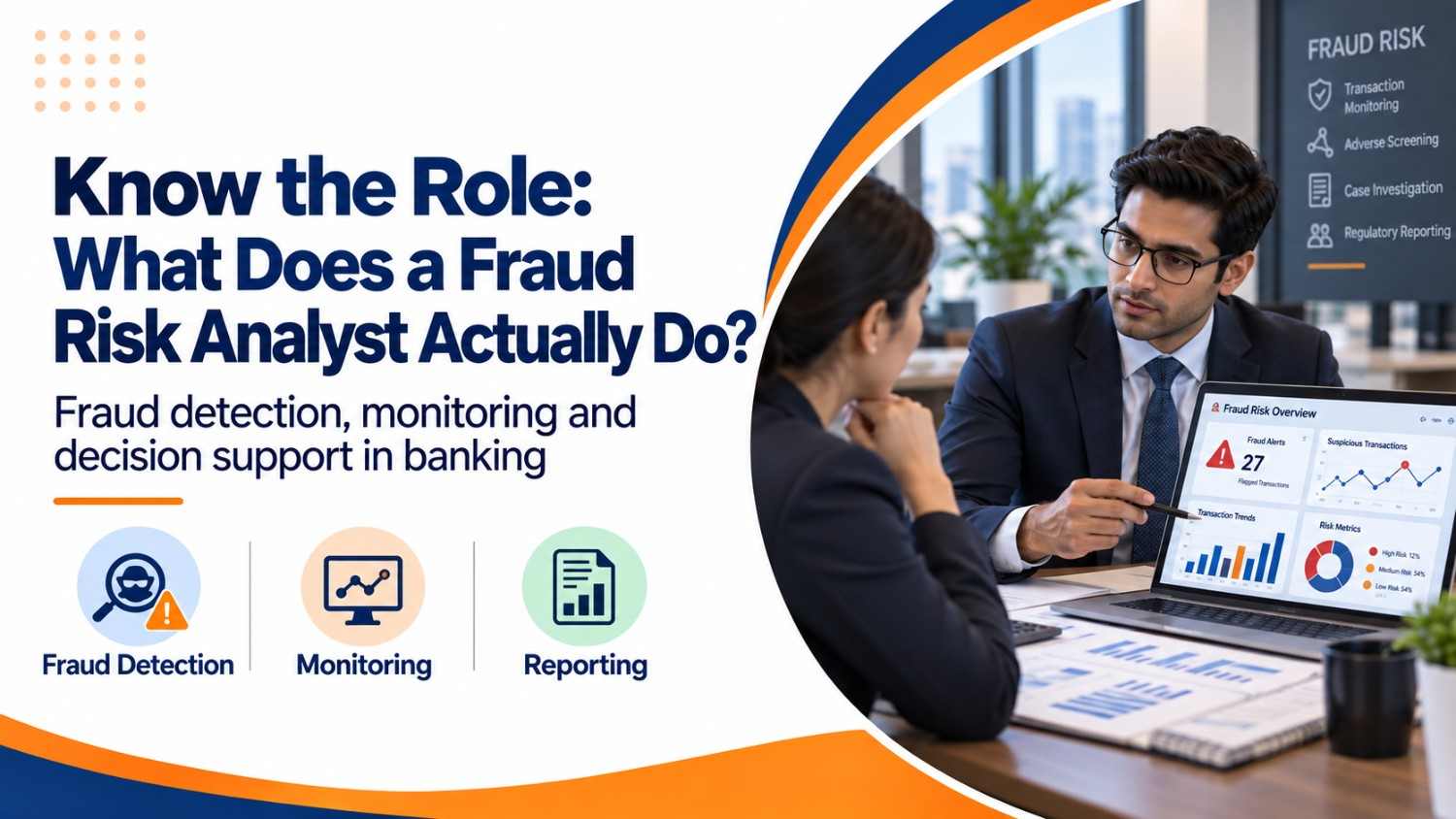
Know the Role: What Does a Fraud Risk Analyst Actually Do?
Ask someone what a Fraud Risk Analyst does and the answer usually stops at, they look at flagged transactions. That undersells the job considerably. A Fraud Risk Analyst spends the day connecting dots across transaction data, customer behaviour, documentation, and internal processes to catch fraud that a single alert would never reveal on its own. The role sits right at the point where a bank’s monitoring systems generate raw output and where that output has to become an actual decision, escalate, investigate, or close. This piece breaks down what a Fraud Risk Analyst genuinely handles day to day, and why the role has become one of the more consequential functions inside modern banking.
Fraud Risk Analyst Core Responsibility: Reviewing and Interpreting Alerts
The starting point for most Fraud Risk Analysts is the alert queue generated by the bank’s transaction monitoring systems, and this is where the real skill of the role begins to show. Most alerts are false positives, and telling the difference between noise and genuine risk quickly is what separates an effective analyst from one who simply clears a queue.
- Reviewing system generated alerts for unusual transaction patterns, velocity, or amounts that deviate from a customer’s established behaviour
- Cross-referencing alert data against customer profile, KYC information, and account history to judge whether the activity actually looks suspicious
- Prioritising alerts by risk severity, since a Fraud Risk Analyst rarely has time to investigate every flagged transaction with equal depth on a given day
Read Now: Early Warning Signals (EWS) in Banking
Fraud Risk Analyst Investigation Work: Turning a Hunch Into Evidence
Once an alert looks genuinely suspicious, the job shifts from reviewing data to building a case. This investigative stage is where a Fraud Risk Analyst’s judgement matters most, since an incomplete or poorly documented investigation can either miss real fraud or wrongly restrict a legitimate customer.
- Tracing the full transaction trail across accounts, counterparties, and channels to understand how funds actually moved
- Gathering supporting documentation, statements, communications, and system logs, that will hold up if the case is later escalated to law enforcement or regulators
- Interviewing or coordinating with branch staff and relationship managers who may have direct context on the customer or transaction in question
Fraud Risk Analyst and Regulatory Reporting Obligations
Fraud investigation in Indian banking does not end once the analyst reaches a conclusion. It comes with a set of specific, time bound regulatory obligations that the analyst is often directly responsible for tracking.
- Classifying accounts under the Red Flagged Account framework once sufficient suspicion is established, triggering a structured examination process rather than an informal internal note
- Reporting to CRILC within the prescribed timeline once an account meets Red Flagged Account criteria, a step that cannot be delayed without creating a compliance gap of its own
- Filing a Fraud Monitoring Return once fraud is formally classified, within the deadline set by RBI’s fraud risk management framework
Read Now: CRILC Reporting Explained: RBI’s Large Credit Monitoring System
Fraud Risk Analyst Contribution to Pattern Recognition and Prevention
The best Fraud Risk Analysts do not stop at closing individual cases. They look across cases for patterns that point to a systemic weakness, a control gap, or an emerging fraud typology the bank has not fully accounted for yet.
- Identifying recurring fraud typologies across cases, such as mule account networks, structured deposits, or account takeover patterns, rather than treating each case in isolation
- Recommending changes to monitoring rules or thresholds when existing alert logic is missing genuine fraud or generating excessive false positives
- Feeding insights back into staff training and customer facing controls, since front line awareness often catches what a system alert cannot
Fraud Risk Analyst Coordination Across Functions
Fraud investigation rarely stays within one department. A Fraud Risk Analyst typically works across compliance, IT security, legal, and branch operations, which means communication skills matter almost as much as investigative ones.
- Coordinating with compliance and AML teams where fraud indicators overlap with money laundering concerns
- Working with IT and cybersecurity teams on cases involving digital channels, account takeover, or system vulnerabilities
- Liaising with law enforcement and CERT-In where a case requires formal reporting or external investigation support
Skills That Define a Strong Fraud Risk Analyst
The role demands a specific combination of analytical rigour and judgement that is not always taught in a single course or certification, which is part of why experienced fraud analysts are genuinely difficult to hire for.
- Strong analytical and data interpretation skills, enough to spot a pattern across hundreds of transactions rather than evaluating each one independently
- Working knowledge of RBI’s fraud risk management framework, including Red Flagged Account criteria and reporting timelines
- Investigative discipline and clear documentation habits, since a fraud finding is only as strong as the evidence trail supporting it
Fraud Risk Analyst Career Path and Progression
The role offers a fairly well defined progression, particularly for analysts who build depth in a specific fraud typology or channel while keeping a broad enough view to spot cross channel patterns.
- Junior or Associate Fraud Analyst roles typically focus on alert triage and case documentation under closer supervision
- Senior Fraud Analyst and Fraud Investigation Lead roles take on complex, high value cases and direct coordination with compliance and legal functions
- Movement into Fraud Risk Management or broader Financial Crime leadership is common for analysts who develop strong pattern recognition and cross functional coordination skills
Conclusion: Why the Fraud Risk Analyst Role Matters More Than It Looks
A Fraud Risk Analyst is one of the few roles in banking where a single missed pattern can translate directly into financial loss, and where a well caught one can prevent it entirely. Understanding the full scope of the role, alert review, investigation, regulatory reporting, and pattern recognition, gives a much clearer picture of why this function has become central to modern banking risk management.
Build This Capability with RMAI
RMAI supports current and aspiring fraud risk professionals through the Online Course on Fraud Risk Management in Banking and the Online Course on Root Cause Analysis, both directly relevant to the investigation and pattern recognition responsibilities covered above.