
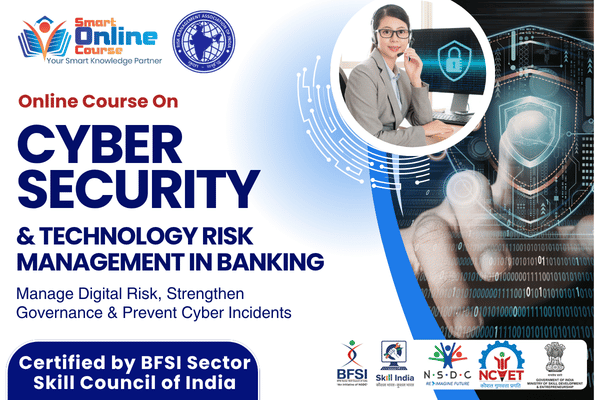
Online Certificate Course on Cyber Security in Banking
Cybersecurity has become one of the most critical risk areas for banks and financial institutions.
As banking increasingly depends on digital channels, APIs, cloud infrastructure, third-party technology providers, and large volumes of customer data, the potential impact of a cyber incident has increased significantly. A serious breach can affect financial performance, regulatory compliance, customer trust, operational continuity, and institutional reputation.
The Online Certificate Course on Cyber Security in Banking is designed to help professionals understand cyber risk from a governance and risk-management perspective.
The programme provides approximately 7 hours of self-paced learning with 120 days of access and focuses on technology risk governance, vendor and cloud risk, access control, data privacy, incident response, escalation, and board-level cyber reporting.
Why Cyber Security Matters in Banking
Banks operate in a highly interconnected technology environment.
Digital banking platforms, mobile applications, payment systems, cloud services, APIs, third-party vendors, customer databases, and internal systems all create operational dependencies and potential cyber exposures.
Key areas of cyber risk can include:
- Third-party technology risk
- Cloud security risk
- API vulnerabilities
- Unauthorized access
- Data privacy breaches
- Weak identity and access controls
- Delayed incident escalation
- Inadequate cyber governance
- Poor board-level visibility
Cybersecurity is therefore not only an IT issue. It is also a risk, governance, compliance, operational, and strategic issue.
Professionals across multiple banking functions need to understand how these risks are identified, monitored, escalated, and governed.
About the Course
The Cyber Security in Banking course provides a structured understanding of technology and cyber risk within the banking environment.
The programme begins with the broader technology-risk landscape before moving into vendor, cloud, and API risk oversight.
Learners then explore access control, data privacy, incident response, escalation, and board reporting.
The emphasis is on governance and accountability rather than purely technical cybersecurity operations.
This makes the course relevant not only for IT and cyber professionals but also for risk managers, compliance teams, auditors, senior management, governance professionals, and banking decision-makers.
What Will You Learn?
By completing the programme, participants will develop a stronger understanding of:
- Technology risk in banking
- Cyber risk governance
- Roles and responsibilities
- Vendor and third-party risk
- Cloud risk oversight
- API-related cyber exposures
- Access control
- Data privacy governance
- Incident response
- Escalation frameworks
- Cyber risk reporting
- Board-level transparency
The objective is to help learners understand how cyber risks should be governed across the institution, not simply how individual technical threats operate.
Course Curriculum
The programme includes five focused modules.
Module 1: Technology Risk Landscape & Governance Responsibility
This module introduces the technology-risk environment faced by banks and financial institutions.
Learners develop an understanding of how cyber, operational, technology, and governance risks are interconnected.
The module also focuses on accountability, ownership, and the importance of clearly defined responsibilities for technology risk.
Module 2: Vendor, Cloud & API Risk Oversight
Banks increasingly depend on external technology providers and interconnected digital ecosystems.
This module examines the risks associated with:
- Third-party vendors
- Cloud environments
- Outsourced technology services
- APIs
- Digital integration
Learners understand why institutions need structured due diligence, monitoring, controls, and governance for external technology dependencies.
Module 3: Access Control & Data Privacy Governance
Unauthorized access and poor data governance can create major operational and regulatory risks.
This module focuses on access management, user privileges, data handling, privacy, and governance.
It helps learners understand how strong access controls and clear responsibility can reduce exposure to cyber incidents and data breaches.
Module 4: Incident Response & Escalation Governance Model
Cyber incidents require timely identification, escalation, communication, and response.
This module explains how banks can establish structured incident-response and escalation models.
Learners explore how roles, responsibilities, response timelines, communication channels, and management oversight can influence the effectiveness of cyber incident handling.
Module 5: Board Reporting & Cyber Risk Transparency
Senior management and boards need clear visibility into cyber risk.
This module focuses on how cyber risk can be communicated through structured reporting, key risk indicators, governance dashboards, and escalation frameworks.
The objective is to help decision-makers understand the nature, severity, and business impact of cyber risks.
Who Should Enroll?
The course is particularly relevant for:
- Banking professionals
- Financial services professionals
- Risk management teams
- Compliance professionals
- IT professionals
- Cybersecurity professionals
- Internal auditors
- Technology governance teams
- Senior managers
- Board and management support functions
- Operational risk professionals
- Digital banking professionals
- Students pursuing careers in cyber risk or BFSI
It can also be useful for professionals who work with technology vendors, digital transformation programmes, or third-party risk.
Key Skills You Can Develop
The programme can help strengthen your understanding of:
- Cyber risk governance
- Technology risk management
- Vendor risk oversight
- Cloud risk management
- API risk
- Access control
- Data privacy
- Incident response
- Escalation frameworks
- Cyber reporting
- Governance accountability
- Board-level risk communication
These capabilities are relevant across banks, NBFCs, fintechs, payment businesses, and other financial institutions.
Course Highlights
Course: Cyber Security in Banking
Duration: 7 Hours
Access Validity: 120 Days
Mode: Self-Paced Online Learning
Learning Method: Practical + Case Study-Based
Level: Beginner to Advanced
Focus: Cyber Risk Governance, Technology Risk & Incident Management
The programme is designed to provide a business and governance view of cybersecurity rather than a narrow technical focus.
Career Relevance
Cyber risk knowledge can support roles such as:
- Cyber Risk Analyst
- Technology Risk Professional
- Information Security Governance Professional
- Operational Risk Analyst
- Compliance Professional
- Internal Auditor
- Third-Party Risk Analyst
- Digital Banking Risk Professional
- IT Governance Professional
- Cybersecurity Manager
For students and early-career professionals, the course can provide useful exposure to one of the most important risk areas within modern banking.
Interested in the Cyber Security in Banking Course?
If you want to strengthen your understanding of technology risk, cyber governance, vendor and cloud oversight, incident response, and board-level reporting, this programme provides a structured learning pathway.
Request Course Information
Not ready to enrol yet?
Complete the study enquiry form to receive more information about the course, certification, fee, and enrolment process.
Speak to Our Team on WhatsApp
Have questions about the course or want guidance before enrolling?
Sales / Course Enquiry
Mobile number: 82320 83010
Email: info@smartonlinecourse.org
Frequently Asked Questions
What is the duration of the course?
The programme includes approximately 7 hours of learning.
How long is course access available?
Learners receive 120 days of access.
Is this course only for IT professionals?
No. It is also suitable for risk, compliance, audit, governance, operations, and senior management professionals.
Does the course cover cloud and vendor risk?
Yes. A dedicated module covers vendor, cloud, and API risk oversight.
Are incident response and escalation included?
Yes. The programme includes a separate module on incident response and escalation governance.
Does it cover board-level cyber reporting?
Yes. A dedicated module focuses on board reporting and cyber risk transparency.
Build Stronger Cyber Risk Governance Skills
Cybersecurity in banking is not only about defending systems. It also requires strong governance, accountability, risk oversight, escalation, and management reporting.
The Online Certificate Course on Cyber Security in Banking brings these areas together in a focused 7-hour self-paced programme with 120 days of access.
Explore the course, submit an enquiry, or speak with the course team to know more.