

India’s Data Centre Growth: Why Banks Should Care
At 10:02 on a busy morning, a customer makes a payment to a supplier through a banking app. Within seconds, the screen confirms that the transaction has gone through.
For the customer, the experience is simple. Behind that small confirmation message, however, a much larger system is working. Networks carry the transaction, authentication services verify the customer, fraud-monitoring systems examine the activity, servers process and store the data, and backup power and cooling systems keep the infrastructure running.
Digital banking often feels almost weightless. It depends on the physical infrastructure that occupies land, consumes electricity and, in many facilities, uses substantial amounts of water.
That infrastructure is now expanding rapidly across India. Cloud computing, artificial intelligence, digital payments, public digital platforms and online business are all increasing the demand for computing capacity. For banks and other financial institutions, this is no longer a subject that can remain only with technology teams. It has implications for business continuity, outsourcing, customer service, regulatory compliance, credit decisions and sustainability.
India needs more computing capacity. The more important question is how that capacity is built, where it is located and how responsibly it is operated.
A market moving into a new scale
India’s data-centre market has changed significantly over the past few years. What was once largely a collection of enterprise server rooms has grown into a network of large colocation campuses, cloud regions and increasingly AI-oriented facilities.
The Council on Energy, Environment and Water (CEEW) reported in February 2026 that India’s installed data-centre capacity increased from about 520 MW in 2020 to nearly 1.5 GW by the middle of 2025. Market projections reviewed by CEEW place the possible capacity by 2030 in a broad range of 4.5 GW to 6.5 GW.
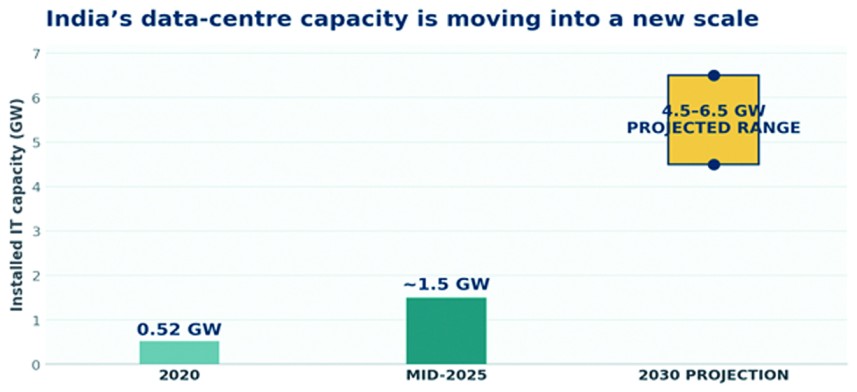
Figure 1: India’s installed data-centre capacity – 2020, mid-2025 and projected range for 2030
The wide range itself is worth noting. Announcing a project is one thing; making it operational is another. Land must be secured, power and transmission infrastructure must be available, equipment has to be commissioned, customers need to take up capacity, and cooling arrangements must work reliably.
The Council on Energy, Environment and Water (CEEW) identified around 271 publicly known data centres in India as of January 2026. Mumbai accounts for close to one-fourth of them, supported by its financial ecosystem, submarine cable landings and dense connectivity. Chennai has similar cable advantages and a strong industrial base. Hyderabad and Bengaluru benefit from technology companies and enterprise demand, while Delhi-NCR serves a large government, telecom and northern India market.
Artificial intelligence is adding further pressure to this expansion. A conventional business application generally operates on more predictable computing patterns. AI workloads, particularly those using dense GPU infrastructure, generate much more heat within a smaller space and place greater demands on power and cooling.
HCLTech’s July 2026 announcement of investment of up to ₹3,500 crore in AI data centres, with scope to reach 50 MW, is one indication of the direction in which the market is moving.
The IndiaAI Compute Capacity initiative is another sign of the growing national focus on computing infrastructure. As AI adoption increases, access to large-scale computing capacity will become as important as access to software, data and skilled people.
For banks, this growth creates both opportunity and responsibility.
The cloud may be digital, but it still lives somewhere.
Banks increasingly use technology as a service. Applications, storage, analytics, cybersecurity tools and processing capacity may be delivered through cloud providers or specialist data-centre operators.
From the user’s point of view, the service appears virtual. But every service ultimately runs in a physical location.
That facility may belong to a cloud company, a colocation provider, a subcontractor or several parties operating together. As the number of layers increases, the underlying physical dependency can become less visible to the organisation buying the service.
This matters because the availability of a banking service depends on more than the server named in a contract.
Two data centres described as separate may still share the same electricity corridor, telecom route, flood-prone area, water source or cloud-management layer. In such a case, a disaster-recovery arrangement may look independent on paper while still carrying a common point of failure.
Banks therefore need to understand the complete service chain that reaches the customer.
This is especially important for payment processing, mobile banking, fraud monitoring and security operations. During a local disruption, a customer may experience a failed transaction while the bank’s ability to analyse that failure is also affected.
Resilience, therefore, cannot be judged only through an uptime percentage. It requires a clearer understanding of dependencies.
The same principle applies to cloud concentration. Cloud platforms offer financial institutions speed, flexibility and access to capabilities that would be expensive to create independently. These advantages are considerable, but they also create dependence on a relatively small number of large technology providers.
A major incident at one provider can therefore affect many organisations at the same time.
This is why cloud and outsourcing reviews need to ask practical questions. Can an important workload be moved elsewhere? How long would that take? Can backups be restored outside the original platform? Which subcontractors or fourth parties support the service? Has the exit arrangement actually been tested?
These questions may sound operational, but they are ultimately questions about customer service and business continuity.
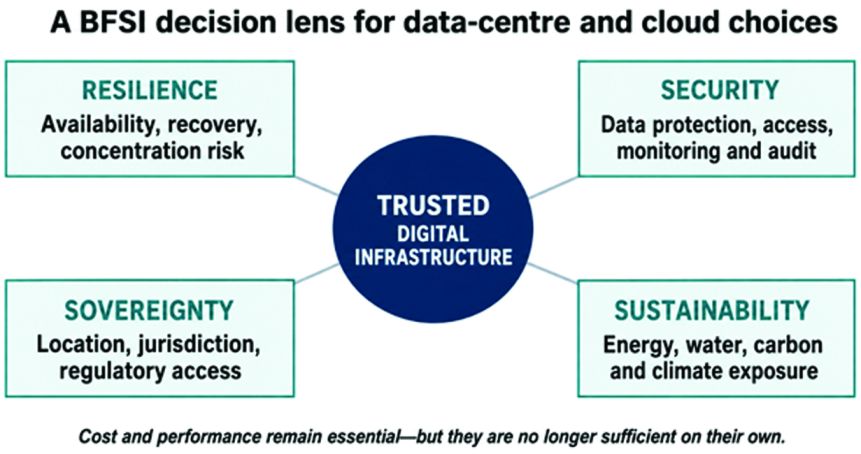
Figure 2: A BFSI decision lens for data centre and cloud choices – Resilience, Security, Sovereignty and Sustainability
Data location is important, but location alone does not make data safe
The growing use of cloud and data-centre infrastructure has also brought greater attention to where data is stored and processed.
The Digital Personal Data Protection Act 2023 and the notified Rules of 2025 have strengthened accountability around the handling of digital personal data. Financial institutions must also meet sector-specific requirements. The Reserve Bank of India requires the entire payment-data system relating to Indian payment transactions to be stored domestically.
Keeping data within India can support supervisory access, reduce some jurisdictional concerns and, in certain cases, improve latency.
But domestic hosting should not be confused with good security.A poorly managed database remains poorly managed even if the server is located within the country.
Strong encryption, privileged-access controls, proper segregation, reliable logging, retention rules, secure backup arrangements and tested deletion processes remain essential.
The location of data is therefore one part of sovereignty. Good governance is what gives that location meaning.
The water behind a digital transaction
Power consumption has long been part of the discussion around data centres. Water is now receiving more attention as well.
Every processor converts electrical energy into useful computation and heat. That heat has to be removed if the equipment is to operate safely and continuously.
Different facilities use different cooling methods. Some rely on outside air. Others use refrigerants, chilled-water systems, evaporation, direct-to-chip liquid cooling or immersion cooling.The choice matters because each method has a different impact on energy and water use.
The Council on Energy, Environment and Water (CEEW) estimates that India’s data-centre sector used around 150 billion litres of water in 2024 and that the figure could more than double by 2030.
This number should be used with care. It is an estimate compiled from public and market sources rather than a national total based on compulsory metering. Even so, it is useful because it shows that water can no longer be left out of infrastructure planning.
The Council on Energy, Environment and Water (CEEW) study gives another useful indication of scale. On-site cooling for a typical 100 MW hyperscale facility may require around two million litres of water a day.
Actual consumption can vary sharply. A facility using treated wastewater and a closed-loop cooling system cannot be compared directly with one that depends heavily on potable water and evaporation. Climate, equipment density, workload and the source of electricity all influence the final footprint.
Local conditions are equally important. Data centres are certainly not the main reason Indian cities experience water shortages. Agriculture, households, leakage, urban growth and other industries account for much larger demand.
The concern is the additional continuous requirement created in places where water systems may already be under pressure.
Mumbai, Chennai, Hyderabad, Bengaluru and Delhi-NCR do not face identical conditions. Yet each has dealt with some combination of high temperatures, flooding, groundwater stress or pressure on municipal systems.
Timing also matters. An annual water figure may look manageable, but it can hide the weeks when temperatures are highest, cooling demand rises and local reservoirs are already stretched.
The source of water matters too. Recycled municipal water places a very different burden on a city from drinking-quality water or uncontrolled groundwater extraction.
For this reason, water reporting should answer a few straightforward questions: How much water is used? Where does it come from? When does demand peak? How much is reused or returned?
Those answers are more useful than a broad environmental claim.
Sustainability needs evidence, not labels
Data centres are often described using terms such as green, efficient or sustainable. Such terms have value only when the measurement behind them is clear.
Water accounting, for example, can differ depending on what is included. One operator may report only the water used directly inside the facility, while another may also consider indirect water consumption associated with electricity generation.
Energy reporting presents a similar challenge.A facility may purchase renewable-energy certificates or enter into a power-purchase arrangement. These measures can support cleaner electricity generation and are valuable. They do not necessarily mean that the data centre runs entirely on carbon-free electricity every hour of the day.
The problem is not the use of such instruments. The problem arises when broad claims are made without explaining what has been measured.
Banks need to be particularly careful when they use a provider’s sustainability claims in their own reporting. A statement such as “green cloud” is not meaningful unless the reporting boundary, measurement method and period are understood. A qualified statement supported by actual operating data is far more credible than an impressive label that cannot be verified.
Cooling technology itself is also improving. Direct-to-chip cooling brings liquid close to the components producing the most heat and is increasingly relevant for high-density AI hardware. Immersion systems place computing equipment in specially designed non-conductive fluids. Closed-loop systems allow water to be reused rather than continuously replaced. Treated municipal wastewater can also reduce reliance on freshwater.
Sensors and workload management can further improve efficiency by ensuring that cooling systems do not operate harder than required.No single technology, however, will be suitable everywhere.
Air cooling may work well for lower-density equipment but struggle with modern GPU installations. Evaporative cooling can reduce electricity use while increasing water consumption. Advanced liquid-cooling systems require compatible hardware, skills and maintenance practices.
The better question, therefore, is not which cooling technology is best in general, but which technology is appropriate for a particular location and workload.
What does this mean for banks
International experience offers useful lessons.
Singapore temporarily restricted new data-centre growth in 2019 when concerns arose over land and energy use. Capacity was later reopened through a more selective approach that placed greater emphasis on efficiency. Its Green Data Centre Roadmap continues to link further development with performance expectations.
India does not need to follow the same policy model. The useful principle is broader: where resources are limited, growth should come with clear conditions.
India’s own diversity also makes a single engineering model difficult. A design suitable for Mumbai may not be appropriate for Hyderabad, Bengaluru, Chennai or a smaller city. Climate, power availability, water sources, flood risk and local infrastructure all differ.
For banks, this has implications in two different roles.
The first is as a customer of cloud and data centre services.
Technology procurement should examine security, resilience, portability and concentration risk, but sustainability should also become part of the conversation. A low-cost solution may appear attractive until weak infrastructure or resource constraints begin to affect reliability.
The second role is as a financier of data centre projects.
Credit appraisal should look beyond projected revenue and customer contracts. Availability and legal security of power and water, cooling technology, commissioning capability, concentration of customers, exposure to climate risk and the likely cost of future upgrades can all affect the long-term viability of a project.
In this context, environmental due diligence is not separate from financial due diligence. If a shortage of power or water can delay a project or restrict operations, it is also a credit risk.
Measures such as Power Usage Effectiveness and Water Usage Effectiveness are useful, but only when operators apply them consistently. Annual consumption, the source of water, the recycled share, seasonal peaks and local climate exposure can provide a much clearer picture.
Banks can influence the sector through the questions they ask, the standards they expect from service providers and the projects they choose to finance.
A more complete view of digital growth
India’s digital economy will continue to expand, and the physical infrastructure underneath it will have to expand as well.
The aim should not be to slow that development. Reliable digital infrastructure is essential for banking, commerce, artificial intelligence, public platforms and the wider economy.
But speed and capacity should not become the only measures of progress.
For the BFSI sector, the better approach is to look at data centres through a wider lens: security, resilience, sovereignty, resource use and long-term financial viability.
A transaction completed in milliseconds is valuable to the customer. The infrastructure that makes that speed possible also deserves attention.
The megawatts that power it matter.
The litres used to cool it matter.
And for banks that increasingly depend on, procure and finance this infrastructure, understanding both is becoming part of responsible banking.
Authored by:

Meenakshi Jain
Assistant General Manager(S) & Faculty,
State Bank Institute of Technology
Hyderabad