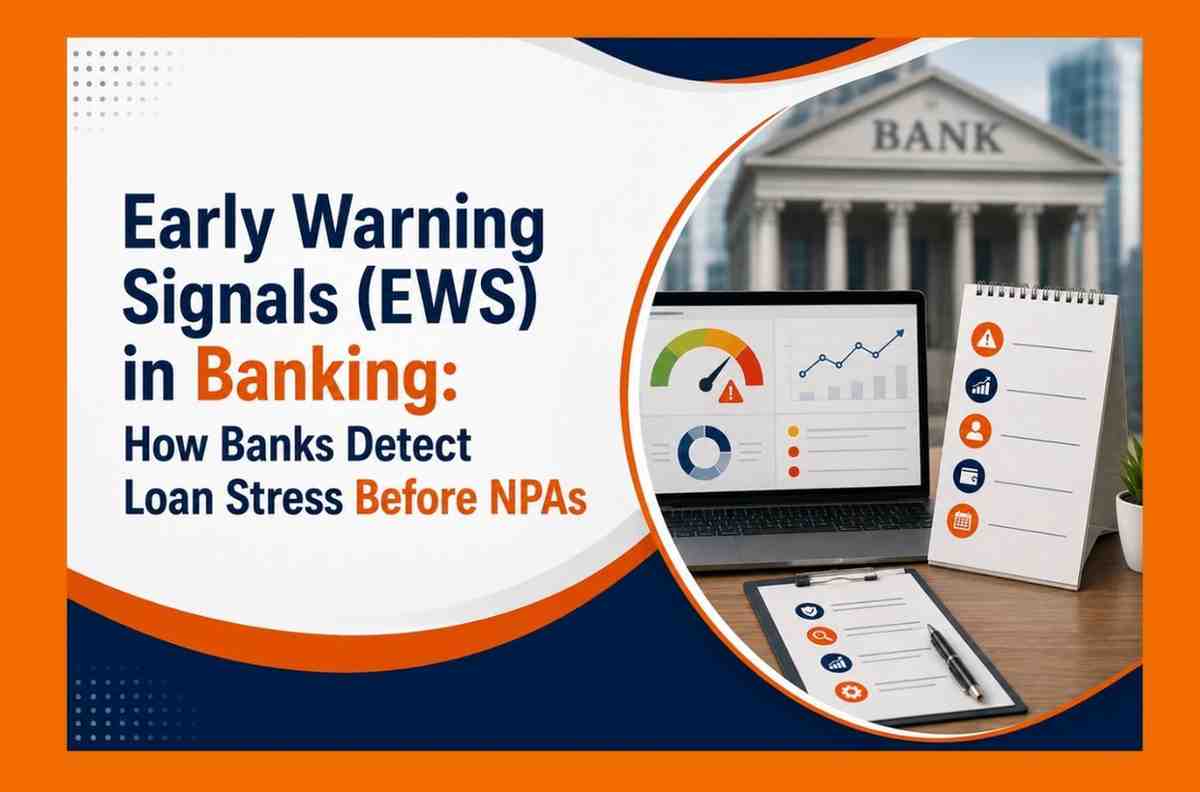
Early Warning Signals (EWS) in Banking: How Banks Detect Loan Stress Before NPAs
A loan account rarely becomes a Non-Performing Asset (NPA) without giving warning signs. Long before repayments stop completely, borrowers often exhibit financial, operational or behavioural indicators that suggest increasing repayment risk. These indicators are known as Early Warning Signals (EWS).
For banks and lending institutions, identifying these warning signs at the right time is one of the most important aspects of credit monitoring. An effective Early Warning Signal framework helps lenders detect stress early, engage with borrowers proactively and reduce the number of accounts that eventually become NPAs.
The Reserve Bank of India (RBI) expects banks to establish robust Early Warning Signal frameworks as part of their overall credit monitoring and fraud risk management processes. Banks are encouraged to use both quantitative and qualitative indicators, supported by data analytics, to identify emerging risks in loan accounts. (System Health)
What are Early Warning Signals (EWS)?
Early Warning Signals are indicators that suggest a borrower’s financial condition or repayment capacity may be weakening.
An Early Warning Signal does not automatically mean the borrower will default. Instead, it alerts the bank that the account requires closer monitoring and further assessment.
Think of EWS as the health check-up of a loan account.
Just as doctors look for symptoms before diagnosing an illness, banks look for warning signs before a loan becomes stressed.
The objective is simple:
Identify problems early → Investigate the cause → Take corrective action → Prevent NPA
Why are Early Warning Signals Important?
Without an effective monitoring system, banks may only realise a problem after repayments stop completely.
An Early Warning Signal framework helps banks to:
- Detect financial stress before default occurs
- Strengthen credit monitoring
- Improve borrower engagement
- Reduce future NPAs
- Improve recovery prospects
- Support better credit decisions
- Meet regulatory expectations
The RBI has also advised banks to maintain integrated Early Warning Signal systems that trigger timely review and remedial action. (System Health)
How Early Warning Signals Fit into the Loan Lifecycle
Every loan generally follows a predictable journey.
Loan Sanction
↓
Regular Monitoring
↓
Early Warning Signals (EWS)
↓
Special Mention Account (SMA)
↓
NPA
↓
Recovery & Resolution
The earlier a warning signal is identified, the greater the opportunity to prevent the account from deteriorating.
Types of Early Warning Signals
Banks monitor several categories of warning indicators instead of relying only on overdue payments.
1. Financial Warning Signals
Financial indicators often provide the earliest evidence of repayment stress.
Examples include:
- Declining sales
- Falling profitability
- Reduced cash flows
- Rising debt levels
- Delayed statutory payments
- Weak debt servicing capacity
- Increasing receivables
- Working capital shortages
These indicators suggest that the borrower’s financial strength may be deteriorating.
2. Transactional Warning Signals
Banks continuously monitor account operations for unusual activity.
Some common examples are:
- Frequent cheque returns
- Declining account turnover
- Irregular interest servicing
- Excess drawings
- Low credit balances
- Large unexplained withdrawals
- Reduced banking transactions
Changes in transaction patterns often appear before loan defaults.
3. Operational Warning Signals
Business operations may reveal problems even before financial statements do.
Examples include:
- Production delays
- Loss of major customers
- Plant shutdowns
- Labour disputes
- Supply chain disruptions
- Delayed project completion
- Declining market demand
Operational challenges often translate into repayment difficulties if not addressed promptly.
4. Behavioural Warning Signals
The borrower’s behaviour itself can become an important risk indicator.
Banks pay attention when borrowers:
- Avoid meetings
- Delay providing financial information
- Ignore bank communications
- Frequently request extensions
- Fail to comply with loan conditions
- Become less transparent
Behavioural changes often indicate underlying financial stress.
5. Documentation and Compliance Warning Signals
Loan documentation must remain complete throughout the loan tenure.
Banks monitor for issues such as:
- Delayed submission of stock statements
- Non-submission of financial statements
- Expired insurance policies
- Delayed renewal of facilities
- Incomplete security documentation
- Failure to comply with sanction conditions
The RBI has also identified several such compliance-related indicators as examples of stress that require attention. (Reserve Bank of India)
Examples of Early Warning Signals
Consider a manufacturing company with a working capital loan.
Over a few months, the bank notices:
- Monthly sales declining
- Three cheque returns
- Delayed stock statements
- Lower account turnover
- Missed interest payment
- Borrower postponing meetings
Individually, these events may not appear serious.
However, together they indicate increasing financial stress.
A proactive credit officer would investigate the account immediately instead of waiting until it becomes an NPA.
What Should Banks Do After Identifying an Early Warning Signal?
Identifying the warning is only the first step.
Banks should then:
Review the Account
Understand whether the issue is temporary or structural.
Engage with the Borrower
Discuss the reasons behind the warning signals and understand the borrower’s repayment plan.
Increase Monitoring
Monitor transactions, repayments and financial information more frequently.
Verify Documentation
Ensure all loan documents, collateral records and insurance remain valid.
Escalate When Necessary
If multiple warning signals appear, the account should be reviewed by the Credit Monitoring or Stressed Asset Management Team.
Early action often prevents further deterioration.
Who Monitors Early Warning Signals?
Monitoring is a shared responsibility across multiple banking departments.
| Department | Role |
| Branch Manager | Initial borrower engagement |
| Credit Officer | Account review and monitoring |
| Credit Monitoring Team | Analyse warning indicators |
| Credit Risk Team | Portfolio risk assessment |
| Stressed Asset Team | Resolution planning |
| Internal Audit | Review compliance and controls |
Modern banks also use automated systems that generate alerts based on predefined risk parameters.
Common Mistakes While Monitoring Early Warning Signals
Banks should avoid:
- Ignoring repeated warning indicators
- Relying only on overdue reports
- Delayed borrower engagement
- Poor documentation
- Failure to escalate high-risk accounts
- Treating every warning signal as an isolated event
Effective monitoring requires both technology and professional judgement.
How Early Warning Signals Prevent NPAs
Many successful recoveries begin with timely identification of stress.
When banks detect warning signals early, they can:
- Understand the borrower’s financial challenges
- Offer appropriate solutions where permissible
- Increase monitoring
- Strengthen recovery planning
- Reduce loan losses
- Improve portfolio quality
This is why Early Warning Signals are considered one of the most important tools in modern credit risk management.
Frequently Asked Questions
What are Early Warning Signals in banking?
Early Warning Signals (EWS) are indicators that suggest a borrower may be experiencing financial or operational stress, allowing banks to investigate before the loan becomes an NPA.
Does an Early Warning Signal mean the borrower will default?
No. An Early Warning Signal indicates increased risk, not certain default. Many borrowers recover after timely corrective action.
Who monitors Early Warning Signals?
Branch Credit Teams, Credit Monitoring Departments, Credit Risk Teams, Internal Audit and Stressed Asset Management Teams collectively monitor warning indicators.
What happens after an Early Warning Signal is identified?
Banks generally review the account, engage with the borrower, verify financial information, increase monitoring and, where necessary, escalate the account for further review.
Key Takeaways
Early Warning Signals are the foundation of effective credit monitoring. Rather than waiting for a borrower to miss several repayments, banks use financial, transactional, operational and behavioural indicators to detect stress at an early stage.
By identifying problems early and taking timely corrective action, banks can improve recovery outcomes, strengthen portfolio quality and significantly reduce the number of accounts that eventually become NPAs.
For every credit officer, branch manager and loan monitoring professional, recognising Early Warning Signals is one of the most valuable skills in the lending lifecycle.
Related Professional Learning
Professionals working in Credit Monitoring, Branch Banking, Loan Administration, Recovery, Credit Risk and Stressed Asset Management can build practical expertise through the NPA Management and Stressed Asset Governance course. The programme covers Early Warning Signals (EWS), SMA classification, NPA recognition, stressed asset resolution, recovery strategies and RBI regulatory expectations.