
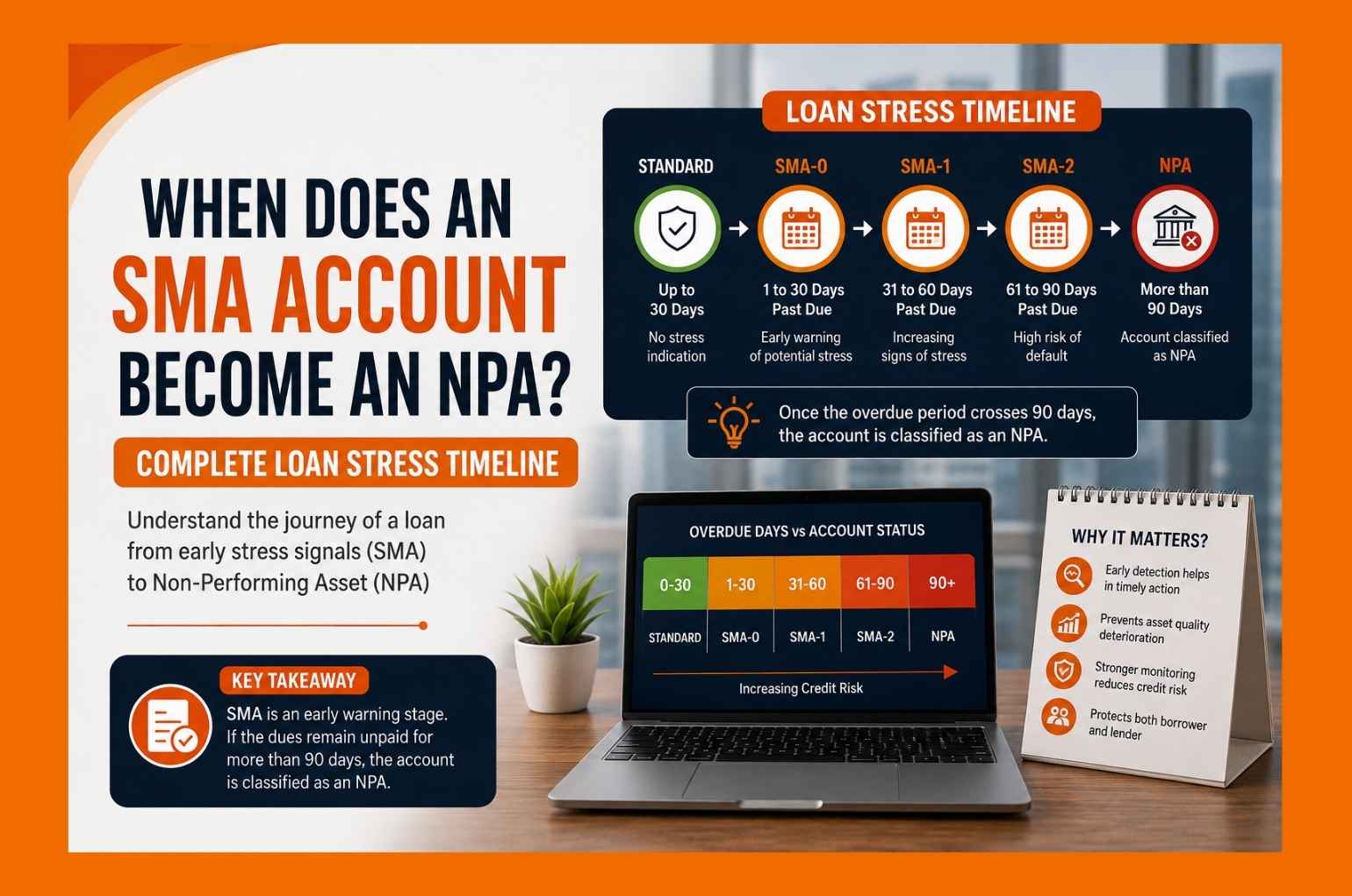
When Does an SMA Account Become an NPA? Complete Loan Stress Timeline
A loan rarely becomes a Non-Performing Asset (NPA) overnight. In most cases, it goes through different stages of repayment stress before reaching that point. This is why banks closely monitor overdue loan accounts using the Special Mention Account (SMA) framework.
Understanding how an account moves from SMA-0 to SMA-1, SMA-2 and finally to NPA is essential for professionals working in credit monitoring, branch banking, recovery, lending and risk management. It helps banks identify financial stress early, engage with borrowers proactively and minimise credit losses.
Under the Reserve Bank of India’s prudential norms, banks are required to identify stressed loan accounts based on the number of days a payment remains overdue and classify them accordingly. For most term loans, an account generally becomes an NPA when the principal or interest remains overdue for more than 90 days. (Reserve Bank of India)
What is the Difference Between an SMA Account and an NPA?
Many people assume that a missed loan payment immediately makes a loan an NPA. This is incorrect.
An SMA (Special Mention Account) is an account showing early signs of repayment stress, whereas an NPA (Non-Performing Asset) is an account where the repayment default has crossed the regulatory threshold.
Think of SMA as the warning stage and NPA as the default stage.
The objective of SMA classification is to give banks enough time to identify problems, communicate with borrowers and take corrective action before the account becomes non-performing.
The Loan Stress Timeline
A typical loan moves through the following stages:
Regular Loan Account
↓
Payment Due Date
↓
Payment Becomes Overdue
↓
SMA-0 (1–30 days overdue)
↓
SMA-1 (31–60 days overdue)
↓
SMA-2 (61–90 days overdue)
↓
NPA (More than 90 days overdue for eligible term loans)
This timeline applies to loans other than revolving credit facilities. Cash credit, overdraft and certain agricultural loans follow different classification rules under RBI guidelines. (Reserve Bank of India)
Stage 1: Regular Loan Account
At this stage:
- EMIs or instalments are paid on time.
- Interest is serviced as per the loan agreement.
- The account is considered a standard asset.
- No repayment stress exists.
The bank continues routine monitoring of the account.
Stage 2: Payment Becomes Overdue
A payment becomes overdue when it is not received on the scheduled due date.
For example:
- EMI Due Date: 5 August
- EMI Not Paid: 5 August
- From 6 August, the payment becomes overdue.
This overdue period forms the basis for SMA classification.
Stage 3: SMA-0 – The First Warning
When the overdue continues for up to 30 days, the account generally falls under SMA-0.
At this stage, banks understand that the borrower may be facing temporary financial difficulties.
Common reasons include:
- Cash flow mismatch
- Delayed customer payments
- Temporary business slowdown
- Salary delays
- Operational issues
What does the bank do?
Banks generally:
- Contact the borrower
- Understand the reason for delay
- Monitor repayment behaviour
- Record follow-up actions
- Watch for additional warning signals
Many accounts return to normal during this stage.
Stage 4: SMA-1 – Increasing Financial Stress
If repayment continues to remain overdue for 31 to 60 days, the account generally moves into SMA-1.
The delay is now no longer viewed as temporary.
Banks begin a more detailed review of:
- Borrower’s financial condition
- Business performance
- Cash flows
- Account conduct
- Security coverage
- Compliance with loan conditions
Monitoring becomes more intensive because prolonged delays increase the probability of default.
Stage 5: SMA-2 – Final Stage Before NPA
If the payment remains overdue for 61 to 90 days, the account generally becomes SMA-2.
This is the most critical stage of credit monitoring.
The account is approaching NPA classification, requiring immediate attention.
Typical actions include:
- Detailed credit review
- Borrower meetings
- Review of collateral
- Assessment of repayment capacity
- Resolution planning
- Recovery preparedness
- Escalation to stressed asset teams
The objective is to determine whether the account can still be regularised or whether recovery measures should begin.
When Does an Account Become an NPA?
For most term loans, an account generally becomes a Non-Performing Asset (NPA) when interest or principal remains overdue for more than 90 days.
Once classified as an NPA:
- The asset is no longer treated as a standard loan.
- Banks are required to follow RBI’s income recognition and provisioning norms.
- Recovery efforts become significantly more structured.
- The account may be transferred to specialised recovery or stressed asset teams.
However, different loan products have different NPA criteria. For example:
- Cash Credit (CC)
- Overdraft (OD)
- Agricultural advances
- Bills purchased and discounted
are governed by separate RBI norms. (Reserve Bank of India)
Can an SMA Account Return to Normal?
Yes.
One of the biggest advantages of SMA classification is that it provides an opportunity to prevent an account from becoming an NPA.
If the borrower clears the overdue amount and the account is regularised in accordance with the lender’s policy and applicable RBI norms, the account may continue as a standard asset.
This is why early borrower engagement is so important.
Who Handles Each Stage Inside a Bank?
Loan stress management involves multiple departments.
| Stage | Primary Team Responsible |
| Regular Account | Branch & Relationship Manager |
| SMA-0 | Branch Credit Team |
| SMA-1 | Credit Monitoring Team |
| SMA-2 | Credit Monitoring & Stressed Asset Team |
| NPA | Recovery, Legal & Stressed Asset Management Team |
| Post-NPA | Recovery, Legal, Finance & Senior Management |
Each department has a specific role, ensuring that stressed accounts are identified, reviewed and managed effectively.
Why Early Identification Matters
Waiting until a loan becomes an NPA reduces the chances of successful recovery.
The SMA framework helps banks:
- Identify repayment problems early
- Strengthen borrower communication
- Improve portfolio quality
- Reduce future NPAs
- Support better credit decisions
- Protect the bank’s financial health
For credit officers, SMA monitoring is therefore one of the most important responsibilities in the lending lifecycle.
Common Misconceptions
“Missing one EMI means the account is an NPA.”
No. A missed payment first becomes overdue and generally enters the SMA framework before NPA classification.
“Every SMA account becomes an NPA.”
Not necessarily. Many borrowers clear their dues during the SMA stages and continue as standard accounts.
“Only recovery teams handle stressed loans.”
Incorrect. Branches, credit monitoring, risk, legal, finance and recovery teams all play important roles throughout the process.
Frequently Asked Questions
How many days does it take for an SMA account to become an NPA?
For eligible term loans, an account generally progresses from SMA-0 to SMA-2 and may become an NPA if the overdue exceeds 90 days, subject to applicable RBI norms. (Reserve Bank of India)
Is SMA better than NPA?
Yes. SMA is an early warning stage that gives banks an opportunity to resolve repayment issues before the account becomes non-performing.
Can banks recover SMA accounts?
Yes. Many SMA accounts are regularised through borrower engagement, repayment planning and continuous monitoring.
Who monitors SMA accounts?
Credit Monitoring Teams, Branch Credit Officers, Credit Risk Teams and Stressed Asset Teams collectively monitor SMA accounts depending on the stage of financial stress.
Key Takeaways
An account does not suddenly become an NPA. It usually progresses through SMA-0, SMA-1 and SMA-2, giving banks valuable time to identify repayment stress and take corrective action.
For banking professionals, understanding this loan stress timeline is critical for effective credit monitoring, early intervention and improved recovery outcomes. Strong SMA monitoring not only reduces NPAs but also strengthens the overall quality of a bank’s loan portfolio.
Related Professional Learning
Professionals working in credit monitoring, branch banking, stressed asset management, recovery and loan administration can deepen their understanding through the NPA Management and Stressed Asset Governance course, which covers SMA classification, early warning signals, NPA recognition, recovery strategies and RBI regulatory expectations.