

RETURNING TO INDIA – THE FINANCIAL MAP EVERY NRI NEEDS
From visa uncertainty to late night family calls, many overseas Indians are quietly preparing for a journey home. For years the idea of returning to India after settling abroad felt distant for most Non-Resident Indians. Today it is no longer unusual. A growing number of NRIs are actively examining what it would mean to come back.
For some the decision is driven by hope. India now offers a vibrant start up ecosystem, a wide range of professional roles, comparatively lower living costs and easier access to family support. For others the decision is shaped by pressure. Work visas feel less secure in several countries, taxes have become more demanding, housing and childcare costs have risen, and competition in certain job markets has intensified. Coming back to India however is not just about booking a flight and packing bags.
It is a deep life transition that affects work, money, relationships and identity. Returning NRIs must make choices about where to live, how to work, what to do with assets abroad, how to handle tax rules and how to help children adapt to a new environment. The emotional and practical sides are strongly linked. A thoughtful financial plan eases emotional stress, and a realistic emotional outlook leads to better financial decisions.
This article explores the main issues NRIs face when planning a homecoming and explains how to approach the transition in a structured way.
No single script for returning NRIs
There is no standard template for an NRI who wishes to return. Some individuals come back after a decade or more abroad. Others move back much earlier after three to five years. A few returns in stages by spending a few months each year in India before finally relocating. Families may return together, or one partner may move first while the other continues to work abroad for some more time.
Motivations differ as well. Some return to build businesses in India after observing strong growth and opportunity. Others decide that being close to ageing parents and extended family is more important than the professional or lifestyle advantages of their host country. Many parents wish to raise children with closer cultural roots, regular contact with grandparents and a familiar social context. Some wish for a simpler life after years of intense work abroad.
Uncertainty also plays a role. Changes in immigration policies can limit long term visibility. Restructuring in certain industries can make employment less stable. Rising costs in education, healthcare and housing can prompt families to explore whether a life in India might offer a better balance between income and expenses.
Each journey is therefore highly personal. What works for one family may not suit another. It is important for NRIs to avoid copying the choices of friends or colleagues without examining their own priorities. A clear understanding of why they want to move back is the starting point for every other decision.
Clarifying intentions before making moves
Before taking concrete steps NRIs need to ask themselves a few basic questions.
- Is the move meant to be permanent?
- Is the family only testing life in India for a few years?
- Will one partner continue to have professional or financial ties to the previous country
- Are children at a stage where relocation will be comparatively easier or will it disturb crucial schooling years?
- How stable are visa‑related issues and the broader political landscape in the country they are leaving, as well as in India, since changes in policy or geopolitical conditions can directly affect long‑term security and opportunities?
If the decision is clearly permanent, then financial and legal arrangements can be changed in a more decisive way. Assets can be gradually shifted to India, long term housing can be planned, and local career options can be built with a long horizon.
If the decision is exploratory then it may be wiser to keep some structures flexible. In such cases families may keep a higher proportion of financial assets abroad, maintain some form of professional link to the previous market or avoid large irreversible commitments like buying property in the first year.
The level of certainty about the move influences almost every aspect of planning, from tax strategy to choice of city.
Resetting lifestyle expectations
One of the biggest gaps for many returning NRIs lies in expectations about lifestyle. Life abroad often offers organised public services, predictable systems and relatively clean surroundings. Returning individuals sometimes assume they will replicate the same experience in India immediately. When reality differs, it can cause frustration.
Daily life in Indian cities involves traffic congestion, noise, air quality concerns and crowds. Returning families may also need to adjust to different standards of customer service, bureaucracy in certain processes and the pace of local administration. At the same time India offers conveniences that many people value. Household help is more accessible, professional services like home delivery or repairs are easier to arrange and there is a sense of community that supports day to day life.
The key is to approach the move with balanced expectations. India is not the same country that many NRIs left years ago. It has modern infrastructure in several areas, a strong technology backbone, digital public platforms and growing aspirations. However, it is also varied, uneven and complex. A flexible mindset and willingness to adapt usually leads to better satisfaction than a direct comparison with the previous country of residence.
The financial equation: salaries, costs and inflation
From a financial perspective returning NRIs often experience a sharp change in their income and spending pattern. Salary levels in India can be significantly lower than those in developed markets when expressed in absolute currency terms. At the same time the cost of living in India is usually lower for many categories such as household help, local food, domestic services and certain leisure activities, medical facilities.
However, inflation in India is structurally higher than in many developed economies. This means that while the starting level of expenses may feel comfortable, the cost base tends to rise faster over time. For returning families who begin to earn in rupees it is important to rework their financial plans based on realistic local income and expense projections.
Financial planners often recommend that returning NRIs keep at least 12 to 18 months of expenses in a liquid contingency fund. This provides a safety buffer while they search for suitable work, set up new businesses or adjust to their new cost structure. Those moving from zero tax jurisdictions such as some Gulf countries must also prepare for the impact of Indian income tax on their cash flows.
All existing financial projections that were built on foreign incomes and cost structures need revision. This includes retirement planning, children’s education targets, housing goals and investment strategies.
Planning ahead instead of after arrival
A common mistake is to delay financial planning until after reaching India. The planning process should begin well before the move. Ideally NRIs should start preparations at least a year in advance.
Key steps include:
- Estimating Indian income based on possible roles, markets or business plans
- Mapping expected expenses, including rent or home purchase, schooling, healthcare, transport and daily living
- Identifying which assets abroad will be retained for the long term and which may be gradually brought back
- Understanding tax residency rules and the timing of return
- Reviewing insurance coverage in both countries
- Discussing schooling and lifestyle preferences within the family
Early planning helps in staggering decisions instead of making hurried choices after landing. It also allows better use of tax benefits available during the transition period.
Tax residency: the three stages of coming home
Indian tax law divides individuals into three categories: Non-Resident Indian (NRI) Resident but Not Ordinarily Resident (RNOR) and Resident and Ordinarily Resident (ROR). The shift from one status to another does not depend on emotion or intention alone. It is determined mainly by the number of days spent in India during a financial year and during specified look back periods.
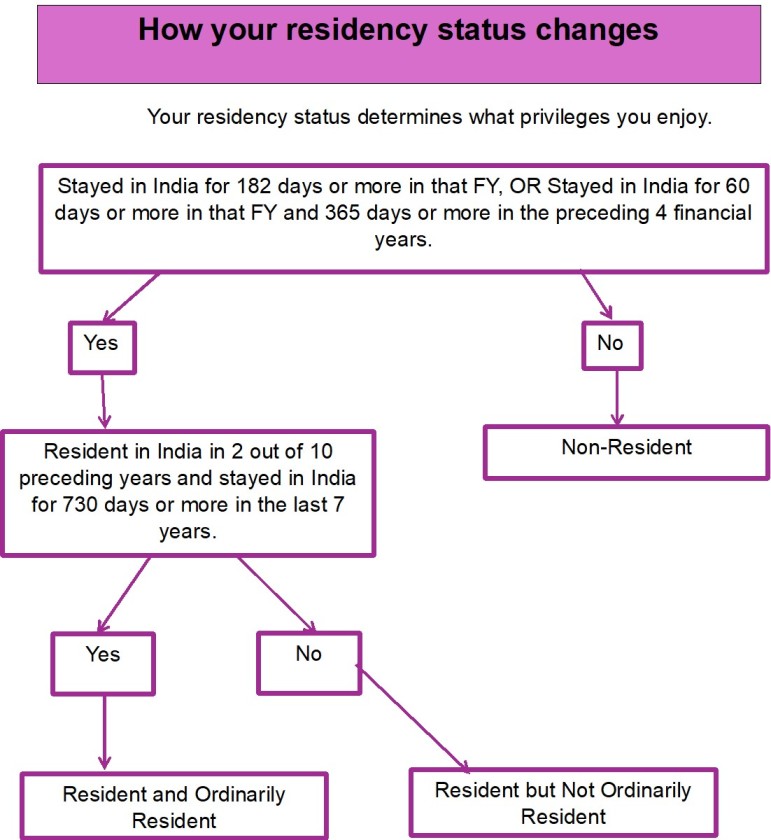 In simple terms an NRI returning to India becomes a resident for tax purposes once they spend at least 182 days in the country during a financial year. However, they may still qualify as RNOR for a specific period if they had non-resident status in most of the previous years or if their stay in India during the last several years was below a defined threshold.
The RNOR period typically lasts for two to three years though the exact duration depends on the individual’s history. During this phase foreign income that is not received in India usually remains outside the Indian tax net. This offers valuable breathing space for returning NRIs to reorganise their finances.
After the RNOR period ends the individual becomes ROR. At that stage their global income becomes taxable in India. This includes salary received abroad, rent from overseas property, dividends and interest from foreign investments, gains from sale of global assets and income from foreign retirement accounts.
| Tax Residency and Income Taxability in India | |||
| Income Type | NRI | RNOR | ROR |
| Income earned or deemed earned within India | Taxable | Taxable | Taxable |
| Income received or considered received in India | Taxable | Taxable | Taxable |
| Income generated outside India | Not Taxable | Not Taxable | Taxable |
Understanding these stages is essential because they influence when to bring money back, when to sell assets and how to structure withdrawals from foreign retirement funds or stock plans.
Using the RNOR window wisely
The RNOR phase can be thought of as a bridge between NRI status and full resident status. During this period many NRIs choose to transfer a portion of their financial assets to India in a phased manner. Doing so may allow them to benefit from exemptions or lower tax impact when compared with the treatment after becoming ROR.
However, it is not always advisable to liquidate everything. Families who may require future dollar funds for children’s education or possible medical treatment abroad may prefer to keep some investments in foreign currency. Holding assets in strong foreign currencies can also provide diversification and protection against local currency depreciation.
The right strategy depends on the size of foreign holdings, the expected use of those funds and the comfort level of the family with global exposure. It is often useful to work with financial planners who understand both Indian and overseas systems.
Handling NRE, NRO and FCNR accounts
Bank accounts are one of the first touch points that need attention after return. Most NRIs typically hold NRE (Non-Resident External) accounts, NRO (Non Resident Ordinary) accounts and sometimes FCNR (Foreign Currency Non Resident) deposits.
| Handling NRI Deposits Upon Return to India | ||
| Account Type | RBI Guidelines | Income Tax Treatment |
| NRO (Non-Resident Ordinary) | Must be converted to a resident account | Taxable; TDS applied during NRI status, now taxed as per resident norms |
| NRE (Non-Resident External) | Should be closed or converted; funds may be moved to RFC | Taxable; cannot be held as a resident |
| FCNR (Foreign Currency Non-Resident) | Can be retained until maturity; post-maturity, convert or transfer to RFC | Tax-exempt until NOR status ends after return |
| RFC (Resident Foreign Currency) | Designed to receive NRE/FCNR proceeds and foreign remittances | Interest income exempt from tax while NOR status is maintained |
Once an individual becomes resident these accounts cannot continue in their original form. NRE and NRO savings accounts must be redesignated as resident accounts or closed as per Reserve Bank of India rules. Balances are generally transferred to normal resident savings accounts.
FCNR deposits are allowed to run until maturity. After that the depositor can either convert the amount into a resident rupee term deposit or transfer it to a Resident Foreign Currency account that maintains balances in foreign currency.
Ignorance or delay in changing the status of these accounts can lead to tax leakages or compliance issues. Therefore, NRIs should plan how and when they will convert their banking relationships before they travel back for good.
Updating investments and brokerage accounts
Besides banking, investments in mutual funds, stocks and other securities need attention. When an NRI becomes a resident the KYC information with asset management companies, registrars and brokers must be updated. This includes a change in residential status, address, contact details and in some cases documentation about tax residency.
If the individual had invested in Indian equities under a Portfolio Investment Scheme account designed for NRIs that account will no longer be valid. It must be closed and a standard resident Demat and trading account has to be opened. Any ongoing systematic investments or redemptions may need to be reviewed and aligned to the new status.
Returning NRIs should also review their asset allocation in the context of Indian income, expense obligations and risk tolerance. For example, a family that relied heavily on foreign currency bonds and overseas mutual funds may need a different mix once their primary expenses shift to rupees.
Insurance and protection: closing the gaps
Health and life insurance policies bought abroad generally do not provide full coverage in India. Some may offer emergency benefits during travel, but they are not designed for long term residence in another country. Once an NRI returns it is important to evaluate protection needs afresh.
Comprehensive health insurance for the family should be a priority given rising medical costs in India. Many returning NRIs also take term life insurance to protect dependants against income loss. If parents or other relatives are financially dependent their needs must be considered as well.
Changes in lifestyle and work patterns can alter risk exposure. Someone who shifts from a corporate job abroad to entrepreneurship in India may face a different set of uncertainties. Insurance is not only a regulatory requirement but a key part of resilience during the transition.
Disclosure of foreign assets and use of tax treaties
After a returning NRI becomes a full resident and ordinarily resident, they have a legal obligation to report foreign assets and income in their Indian income tax return. This is done through Schedule FA which captures bank accounts, financial interests, immovable property, foreign company shares and other specified assets.
Non-disclosure can attract penalties under the Black Money Act along with interest and potential prosecution. It is therefore important to maintain clear records of all foreign holdings, income statements and taxes paid abroad.
At the same time India has Double Tax Avoidance Agreements with many countries. These treaties allow residents to claim credit in India for taxes already paid in the other country on the same income. To use these benefits properly individuals may need a Tax Residency Certificate from the foreign jurisdiction and must file Form 67 to claim foreign tax credit. Proper use of DTAAs reduces the risk of double taxation and helps ensure fair treatment of cross border income.
Decisions on property and other assets abroad
A frequent question for returning NRIs is whether to sell property abroad before moving back or to hold it for some more time. There is no universal answer. The right choice depends on the size of the asset, expected rental yield, tax rules in that country and the family’s long-term plans.
Selling before becoming a full resident may be beneficial in some cases because gains might remain outside Indian tax for the RNOR period. On the other hand, if the property is in a strong market that can provide stable rental income or potential capital appreciation the family may choose to retain it.
Inheritance and estate laws in the foreign country are also important. Some countries are changing their rules around domicile and residence-based taxation of inheritances. Returning NRIs need to understand whether holding property or other assets abroad will create complexity for their heirs later.
Ground level settling in: House, School and City choice
Practical decisions on where to live shape the experience of homecoming. Many families feel pressure to buy a home quickly as a sign of stability. However, experts often advise that returning NRIs spend at least six to twelve months renting or living in family homes before committing to a purchase.
Renting provides flexibility to explore different neighbourhoods, understand commute times, look at school options and experience local facilities. Once the family has clarity about which area suits their needs best they can choose whether to buy or to continue renting.
Schooling is a central concern for parents. Decisions about board, medium of instruction and school culture influence how children adjust to India. Some schools are more familiar with returning students and offer support for transition. Planning the move around academic calendars can reduce disruption.
Choice of city also matters. Some NRIs prefer metro cities with diverse opportunities while others look for smaller cities or hometowns that offer a slower pace. The availability of work, healthcare, education and social networks should be weighed alongside emotional attachments.
Administrative checklist in the first few months
The early months after return are busy. Besides personal and professional adjustments returning NRIs must complete a sequence of administrative tasks. These typically include:
- Changing the status of NRE, NRO and FCNR accounts
- Updating KYC details with all banks and financial institutions
- Redesignating fixed deposits from NRE to resident deposits and understanding how interest will be taxed
- Updating status with mutual funds and brokers and closing NRI specific accounts like PIS where necessary
- Reviewing and updating nominations across bank accounts, investments and insurance policies
- Buying appropriate health and life insurance in India
- Creating a new will under Indian law even if an earlier will exists in a foreign jurisdiction
To simplify planning, here’s a consolidated checklist of key actions NRIs should complete when returning to India. This spans banking, taxation, investments, insurance, documentation and more helping families stay organized during the transition.
| Return to India Checklist | |
| Category | Action Items |
| Banking & Financial Accounts | Convert NRE/NRO accounts to resident savings accounts |
| Close unnecessary NRE/NRO accounts | |
| Consider opening a Resident Foreign Currency (RFC) account | |
| Update KYC details with new residential status | |
| Convert health insurance to Indian equivalent | |
| Reassess loans and credit card obligations in both countries | |
| Investments & Mutual Funds | Convert NRI Demat and trading accounts to resident status |
| Update KYC with mutual fund houses | |
| Reevaluate portfolio and asset allocation | |
| Taxation & Compliance | Update PAN card details |
| File income tax returns as a resident | |
| Declare foreign assets and income | |
| Check DTAA applicability | |
| Obtain Tax Residency Certificate (TRC) if required | |
| Property & Real Estate | Update address in property documents |
| Assess capital gains tax liability | |
| Review taxation on rental income from foreign property | |
| Plan repatriation of property sale proceeds | |
| Insurance & Loans | Update life and health insurance policies |
| Convert international health insurance | |
| PAN & Aadhaar Updates | Ensure all family members have updated PAN and Aadhaar |
| Link PAN with Aadhaar | |
| Update address and contact details | |
| Foreign Assets & Repatriation | Plan repatriation of foreign earnings |
| Understand FEMA limits | |
| Consult financial planner for overseas assets | |
| Ensure capital gains tax compliance | |
| Close unnecessary foreign bank accounts | |
| Estate & Will Planning | Update nominee details |
| Modify or create a new Will | |
| Ensure compliance with Indian succession laws | |
| Employment & Business | Inform employer and update tax withholding details |
| Assess tax/legal implications for overseas business | |
| Transfer professional credentials/licenses | |
| Social Security & Retirement | Check pension withdrawal eligibility |
| Understand Social Security benefits | |
| Plan retirement savings in India (EPF, PPF, NPS) | |
Completing these tasks early prevents complications later and helps create a clean financial base for the family.
Choosing between old and new tax regimes
Returning NRIs who start earning in India must choose between the old tax regime and the newer regime that offers lower rates but fewer deductions. The choice depends on the structure of income and the presence of tax saving investments or loan benefits.
Those who claim deductions under sections such as 80C for provident fund or life insurance, 80D for health insurance or interest benefits on home loans may find the old regime more suitable. Others with fewer deductions may prefer the new regime. The decision can be revisited each year based on evolving circumstances.
During the first few years after return the individual’s status as NRI, RNOR or ROR affects how much of their global income is taxed in India. They must review these rules carefully while filing income tax returns and ideally seek professional advice.
Filing income tax returns after homecoming
Filing requirements depend on both residential status and the level of income. In the year of return an individual may still be NRI for tax purposes if their stay in India remains below the 182 day threshold. In such a case if they have only exempt NRE or FCNR interest they may not be required to file a return. However many still choose to file for record keeping.
Once the person becomes RNOR or ROR and crosses specified income thresholds filing becomes mandatory. In most cases returning NRIs who hold foreign assets or earn foreign income need to use ITR Form 2. They should also review the Annual Information Statement to check if any foreign income has been reported to Indian authorities through exchange of information mechanisms.
Careful filing in the first few years builds a compliant history and reduces the risk of future queries.
Balancing emotion and structure
The decision to return to India is rarely pure finance or pure emotion. It is usually a mix of family ties, aspirations, career choices, lifestyle preferences and risk comfort. Financial planning does not remove the emotional complexity but it creates a safety net that allows families to focus on rebuilding their lives rather than worrying constantly about money.
NRIs who plan their homecoming thoughtfully by understanding tax rules, managing assets, arranging protection and aligning expectations usually experience a smoother transition. Those who rush the move without preparation may face avoidable stress.
India today offers a combination of opportunity, familiarity and support that many returning NRIs value deeply. With realistic expectations and a structured financial approach the journey home can become not just a return to a country but the start of a new and confident chapter.
Welcome Home: A Confident Return for Global Indians
Moving back to India doesn’t mean pressing rewind, it means pressing reset with new possibilities. It’s a chance to bring global experience into a local context, to reconnect with roots while building new possibilities. Whether driven by hope, necessity, or a mix of both, the homecoming journey deserves structure, clarity, and care.
From tax residency to asset repatriation, from school choices to insurance updates, every decision becomes easier when NRIs plan ahead and stay informed. The transition is not just financial it’s emotional, cultural and deeply personal.
India today is not just waiting it’s evolving. With digital infrastructure, entrepreneurial energy and a growing support ecosystem, returning NRIs can find both familiarity and opportunity.
So to every global Indian preparing to return:
Welcome back. Your journey home is not the end of a chapter; it’s the beginning of a new one.
Authored by:

Thangaveni B P,
Research Officer,
State Bank Staff College, Hyderabad